Mini Split Installation in New Albany, IN
A new system here will heat from October through April and cool from May through September every year. Tell us about the house, and a licensed contractor who covers Floyd County will get in touch.
Tell us about the job
It takes about a minute.
What a mini-split here has to handle
Floyd County asks for heat seven months of the year and cooling five, so a mini-split here runs nearly all year round. Winter nights average 26°F, cold enough that the heat pump side has to work hard, and summer afternoons average 86°F on the cooling side. There's almost no season where the unit gets to sit idle.
Any mini-split installed new has to meet the federal minimum for a split-system heat pump, 14.3 SEER2 for cooling and 7.5 HSPF2 for heating. That's the floor a licensed contractor will size and install to, matched to how many months your system actually has to run here.
- 7 months
- October through April, your system heats
- 5 months
- May through September, it cools
- 26°F
- the average winter night it heats against
- 86°F
- the average summer afternoon it cools against
NOAA nClimDiv, 1991–2020 normals
In Indiana, HVAC licensing for homes is left to the counties and cities.
Indiana has no state HVAC license. Licensing is left to counties and cities, so what applies to your mini-split installation depends on the rules where your house sits, not on a state board. There is no state license number to check and no state record of complaints, because the state does not license this work at all.
What covers this job here is the local permit process. In most Indiana cities and counties, installing a mini-split needs a permit from the local building office and an inspection once the work is done. That permit and inspection are the record this job gets, in place of a state license.
Sources: Indiana Department of Workforce Development · State of Indiana
- Is a mini split worth it?
- For the right room or house, yes. A mini split heats and cools without ducts, so it works well in a room that never got comfortable, an addition, or a garage turned living space. Winters here run cold enough, down to 26°F on average, that you want a unit rated for real heating, not just a cooling add-on. A contractor can look at the space and tell you whether a mini split fits better than extending existing ductwork.
- How many rooms can a mini split cover?
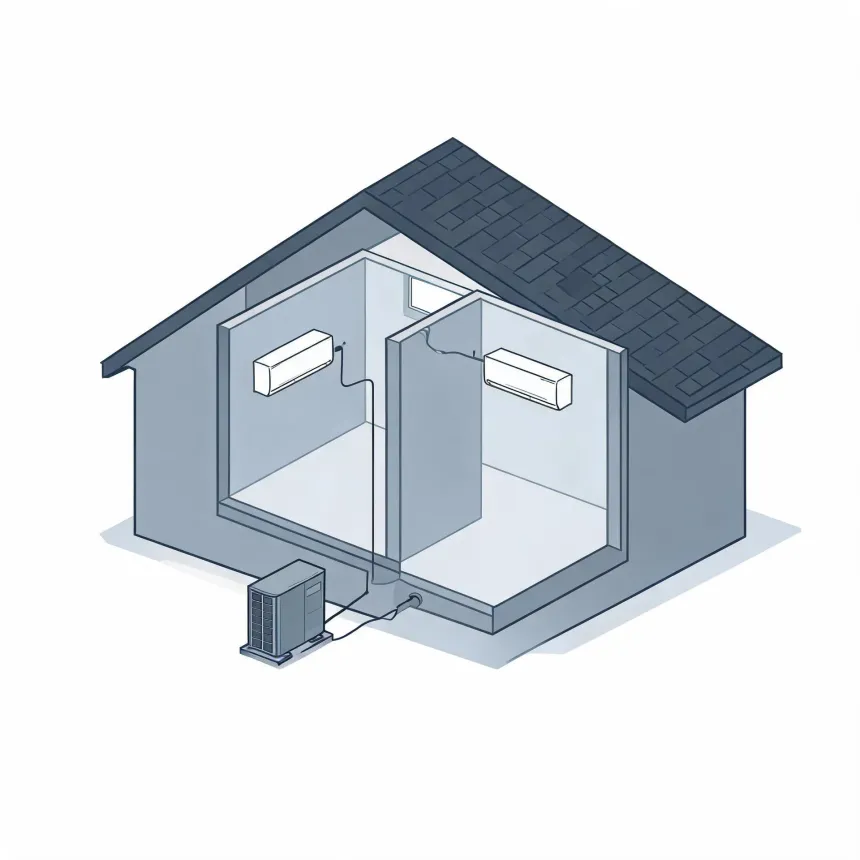
- One outdoor unit can run several indoor heads, so it can cover more than one room at a time. Each indoor head heats and cools the room it is mounted in, and you set the temperature separately in each one. How many heads you need, and how they are sized, depends on the square footage and layout of the rooms, which a contractor works out room by room.
- Can a mini split heat a whole house?
- It can, if enough indoor heads are placed to reach every room. A multi-zone system with one outdoor unit and several indoor heads is built for exactly this. Homes here need heat from October through April, seven months of the year, so the system has to be sized for winter nights near 26°F, not just mild days. A contractor can size the system to the house and confirm it will keep up on the coldest nights.