Mini Split Installation in Jeffersonville, IN
A new system here will heat from October through April and cool from May through September every year. Tell us about the house, and a licensed contractor who covers Clark County will get in touch.
Tell us about the job
It takes about a minute.
What a mini-split in Jeffersonville has to handle
Your mini-split runs almost year round here, heat from October through April, cooling from May through September. That's 12 months of work with barely a break between seasons. Winter nights average 26°F, cold enough that the heat pump side has to work for real, not just take the edge off. Summer afternoons average 86°F, so the compressor puts in long hours the other end of the year too.
A new unit built on or after January 1, 2023 has to meet the federal minimum for a split-system heat pump, 14.3 SEER2 for cooling and 7.5 HSPF2 for heating. Indiana also saw 17% of households go at least 24 hours without power in 2024, so it's worth asking how the system you install handles an outage.
- 7 months
- October through April, your system heats
- 5 months
- May through September, it cools
- 26°F
- the average winter night it heats against
- 86°F
- the average summer afternoon it cools against
NOAA nClimDiv, 1991–2020 normals
In Indiana, HVAC licensing for homes is left to the counties and cities.
Clark County sets its own rule on who can do HVAC work, since Indiana leaves that to the counties and cities. There is no state license behind the contractor's name, no state exam, no state record to check. Whatever licensing applies here comes from the county or the city, not from Indianapolis.
For a mini-split install, most cities and counties require a permit before the work starts, and an inspection once it is finished. That inspection is what checks the work was done right, not a license. It is the closest thing to oversight this job gets in a place with no state license behind it.
Sources: Indiana Department of Workforce Development · State of Indiana
- Is a mini split worth it?
- For most homes here, yes, especially in a room your furnace or central air struggles to reach. Winter lows around 26°F mean you want a unit rated for real cold, and most mini splits sold now are heat pumps built to handle that. They also cool, so the same unit covers you May through September when afternoons hit the mid-80s. Whether it makes sense for your house depends on what you already have and what you're trying to fix, which is where a contractor walks the specific rooms with you.
- How many rooms can a mini split cover?
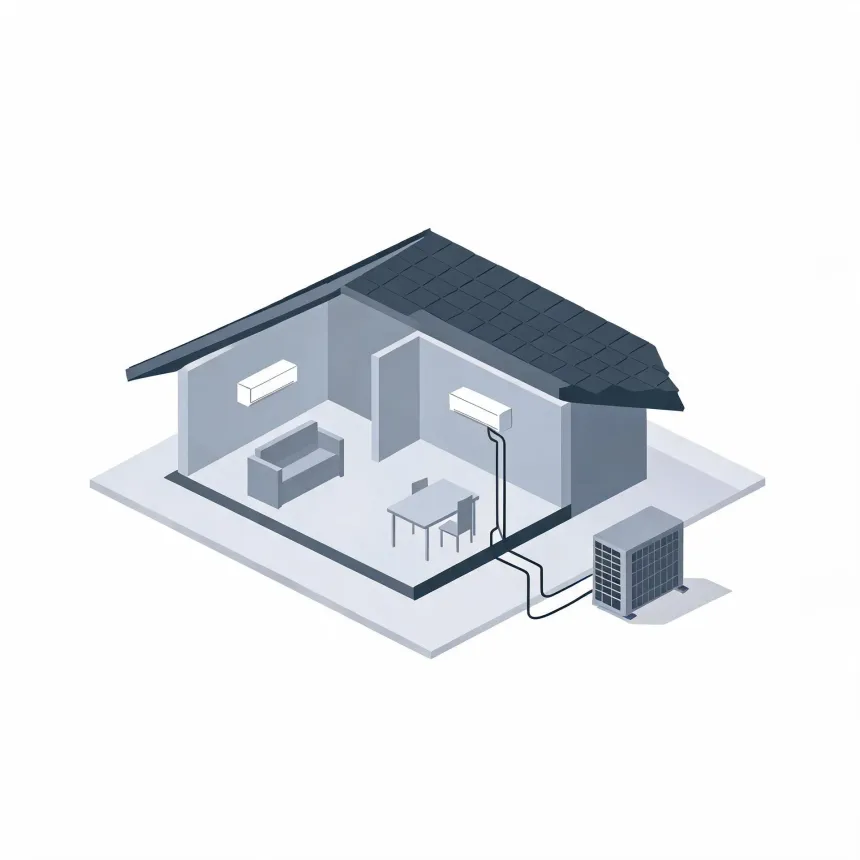
- A single-zone system heats and cools one room. If you need more than that, a multi-zone system runs several indoor units off one outdoor condenser, each with its own thermostat, so you can heat the bedroom and leave the sunroom off. How many zones your house can support comes down to the size of the outdoor unit and the layout of the rooms. A contractor sizes that for your specific house.
- Can a mini split heat a whole house?
- It can, but it takes a multi-zone system sized for every room, not just one indoor unit. With winter nights averaging 26°F here, the outdoor unit and each indoor head need to be sized for that cold, not just for a mild fall day. Plenty of homes here heat with gas already, and for a house like that a mini split often ends up covering specific rooms or backing up the furnace rather than replacing it outright. A contractor can look at your floor plan and tell you whether whole-house coverage makes sense for your home.