Get matched with a pro who works on ducts in Marion County.
You're probably asking because something gave you a reason to. Maybe it's the dust on the registers, an allergy that won't quit, or someone told you it should happen every few years. Duct cleaning is one of those services that's hard to judge from the outside. You can't see inside the ducts, so you're left trusting whatever you're told.
That's the real issue in Marion County homes. A duct system that's never been looked at could be fine, or it could be feeding dust and debris into every room all winter when the furnace runs and all summer when the AC does. There's no way to know without someone actually opening it up and looking.
This is where a local contractor matters more than the service itself. Someone who works on ductwork around Indianapolis sees what tends to collect in these systems, what vents usually get missed, and what's worth cleaning versus what's not. That judgment doesn't come from a brochure. It comes from doing it on homes like yours, season after season.
When you put in a request here, it goes to one contractor, not a handful competing for your business. That contractor is licensed to work in Indiana and local to the Indianapolis area, so they know the ductwork, the furnaces, and the AC setups common here. They'll reach out to you directly to look at your specific system and tell you what they find, not a general answer, but one based on what's actually running through your home.
The rest of this page gets into the straight answer on whether cleaning is worth it and when. But if you'd rather skip ahead and just get someone out to look at your ducts, that's what the button below does.
For most homes in Indianapolis, duct cleaning is worth doing when there's a real reason behind it, not on a set schedule. If no one in the house has allergies, you haven't had rodents or a pest problem in the ducts, and there's no leftover dust or debris from a renovation, cleaning the ducts probably won't change the air you breathe or the bill you pay each month. Ducts carry air; they don't generate dirt on their own, and a clean filter changed on schedule does more for your air quality than a one-time duct cleaning will. Where it does matter is after work on the house, water damage near the ductwork, or visible mold. If you've seen mold inside a vent, or there's a musty smell when the furnace or AC kicks on, that's worth having someone look at, not just clean. Outside of those situations, you're paying for peace of mind more than a measurable difference.
Before you get your ductwork cleaningAfter you get your ductwork cleaning
When it actually helps
Duct cleaning clears out what's built up inside the supply and return runs, the dust, pet hair, and debris that collect on the inside walls of the ductwork over years. If you've had rodents in the attic or a renovation that left drywall dust behind, that material is sitting in there until something pulls it out. Vacuuming registers and changing your filter doesn't reach it. A contractor runs a brush and a vacuum through the whole system, and that's the only way to get at what's past the first few feet of duct.
What it won't fix
Cleaning the ducts doesn't change how much air moves through your house or fix a room that's always too warm or too cold. Those problems usually come from the duct sizing, a blocked return, or the furnace or AC itself, not from dust on the duct walls. It also won't stop new dust from building back up if the filter isn't doing its job or gets changed on the wrong schedule. If the goal is better airflow or lower bills, duct cleaning by itself isn't what gets you there.
Why does duct dust build up so much in an Indianapolis house?
Half the homes here were built by 1973
Half the homes in Marion County were built in 1973 or earlier, so a lot of ductwork here has had decades to collect dust and loose insulation.
Heat runs October through May
Heat runs October through May here, about eight months. That's a long stretch pushing air through the same ducts before anything gets a rest.
Cooling runs June through September
Cooling runs June through September. Add it to the heating months and the system moves air through those ducts most of the year.
ACS 2020-2024 · NOAA nClimDiv 1991-2020
Ductwork that's doing fine
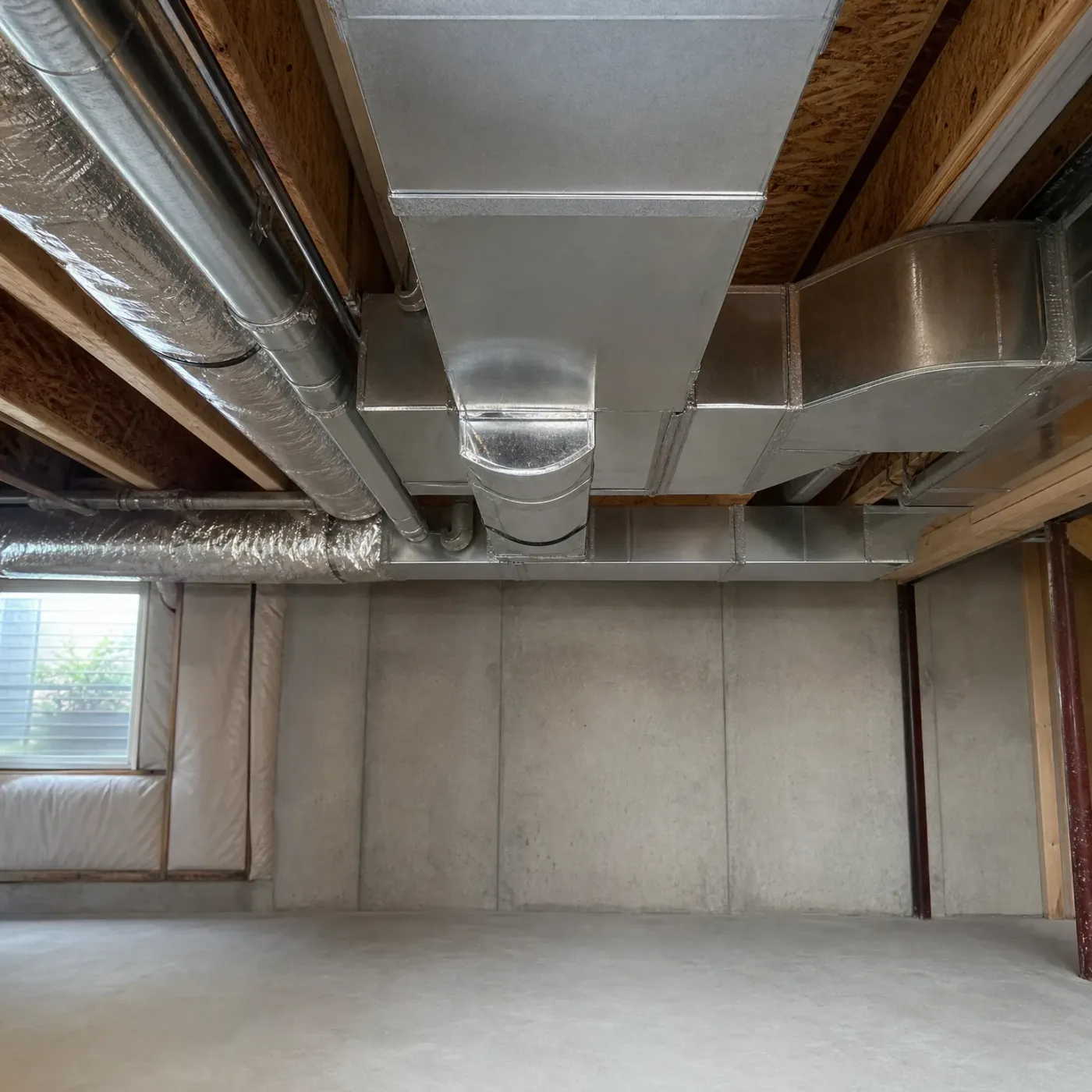
This is what sound ductwork looks like from the basement. The metal trunk lines and flex runs sit tight in the joists, no sag, no crushed sections, no gaps at the connections. Air moves through clean and the system doesn't have to work to push it where it's going.
Ductwork that needs a look
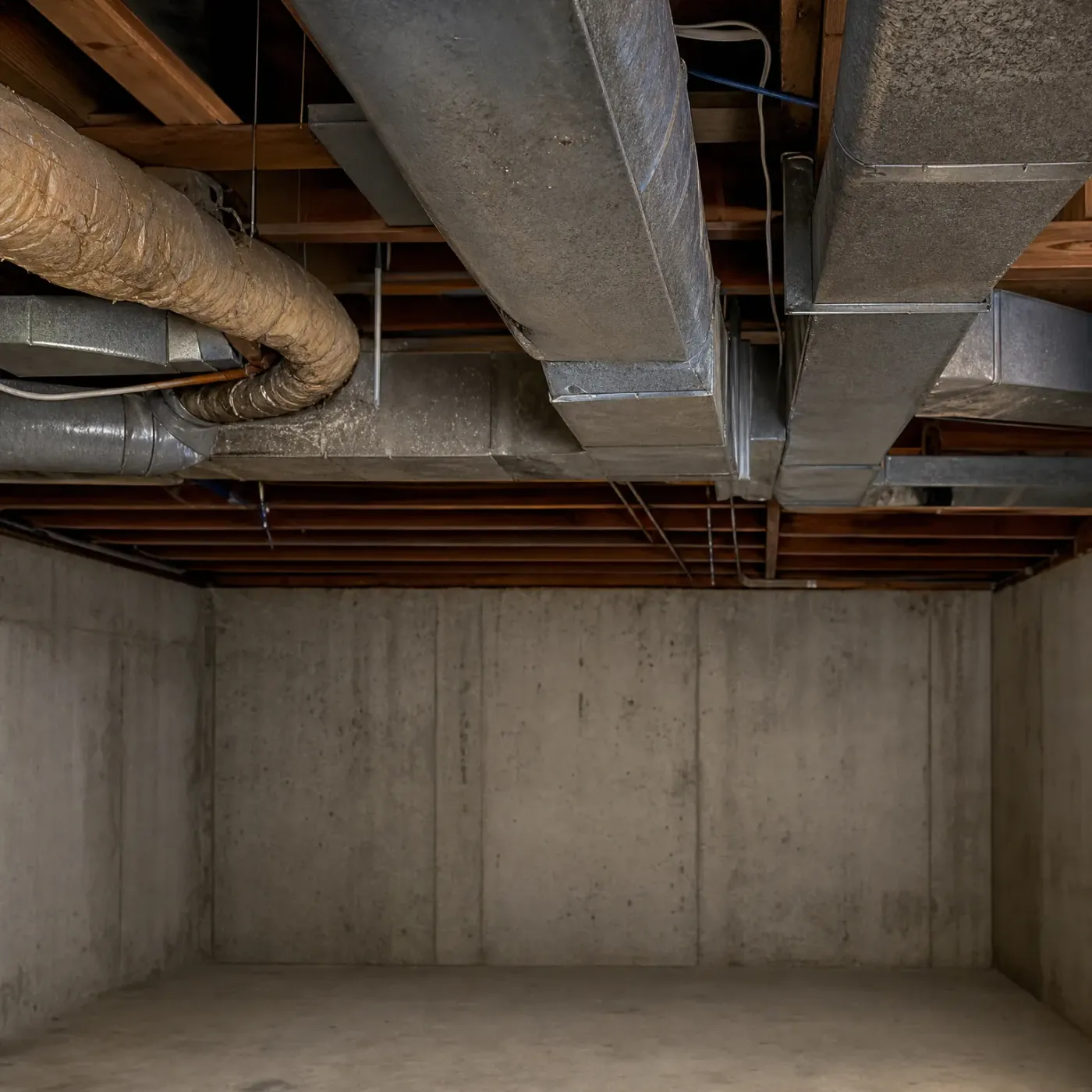
Here the same kind of system shows its age. Loose joints, flex pipe pinched where it crosses a joist, and runs that have sat untouched for years. That's where dust and debris settle and stay, and it's the setup worth having checked before you decide on cleaning.
What's actually coming out of your vents
Pull a return grille off the wall and look at it. If there's a gray felt of dust on the inside, or it puffs out when the blower kicks on, that's been collecting for a while. Some houses show it at the supply registers too, a dark smudge on the ceiling or wall right around the vent. If anyone in the house has started waking up congested, or an allergy seems worse indoors than out, the ducts are worth a look. None of this means the ductwork is damaged. It usually just means dust has had years to settle in there, and it's circulating every time the furnace or AC runs.
Ductwork running clean
This is a basement system with nothing wrong in it. The metal trunk lines sit tight against the joists, the furnace is doing its job in the corner, and the vapor barrier on the block wall keeps groundwater out of the equation. Air moves through without picking up anything it shouldn't.
Ductwork holding dust
Same kind of basement, same metal runs overhead, but years of dust and debris have settled inside the ducts. Nothing looks wrong from here. The sheet metal still hangs right and the joints still hold, but what's coating the inside walls of that ductwork is riding into every room the blower reaches.
A lot of this comes down to what you can't see from the basement stairs. A half-collapsed flex run, a disconnect behind a wall, rodent droppings in a trunk line that's never been opened, those get missed on a quick look and they change the answer. A local contractor who works in Marion County basements every week knows where these systems tend to fail, what a 1970s build is likely to have behind the sheet metal, and whether what you're describing actually points to a cleaning or to something else in the ducts entirely. Send the request through and it goes to one contractor who takes on this kind of job, not a handful of companies competing for the callback. They'll look at your ductwork, tell you what they find, and let you decide from there. If your registers are dusty and no one's touched the system in years, that's worth having someone who knows what they're looking at take a look before you spend money on a guess.
1
A technician seals the supply and return registers with covers.
2
A vacuum unit connects to the main trunk line through an access port.
3
The vacuum pulls the whole system to negative pressure.
4
A brush or air whip knocks dust loose inside each branch run.
Trunk lines and flex runs sit tight against the joists, nothing crushed or sagging, nothing pulled loose at the boots.
The flex run has pulled loose from its branch and dropped against the joists, so conditioned air is leaking into the basement instead of the rooms.
Power here costs 14.77 cents per kilowatt-hour
At 14.77 cents per kilowatt-hour, running your blower longer than it needs to shows up on the bill. A clogged return or a duct system full of dust makes the blower work harder to push the same air through your house, so clearing that buildup is one less drag on it.
EIA-861 2025
When it's worth paying for
If a return grille is gray with dust, if someone in the house has started reacting to something in the air, or if you've had rodents in the attic or a renovation that left drywall dust in the system, cleaning the ducts solves a real problem. A technician who works on duct systems around Indianapolis every week has seen what rodent nesting looks like in a trunk line and what a few years of drywall dust looks like coating a branch run, and knows the difference between a system that needs clearing out and one that just looks dusty at the register. That's worth paying for because it fixes something, not because a schedule says it's time.
When it's money spent on nothing
If nobody in the house has allergies, there's no history of pests in the ductwork, and the dust at the registers is just ordinary household dust, cleaning the ducts doesn't change anything you'd notice. The ducts carry air, the filter is what cleans it, and a duct system with no blockage or contamination doesn't push more dust into the house just because it hasn't been cleaned in a few years. In that case the dust on the registers is coming from the room, not from the ductwork, and a cleaning won't touch the real source. A local contractor can tell you which situation you're in before any work gets scheduled, rather than after.
So is it worth it for your house
If your ductwork hasn't had a pest problem, no one's reacting to the air, and there's no leftover dust from a renovation, you can leave it alone and put the money toward something else. If one of those is true for you, cleaning solves a real problem instead of just checking a box. Either way, pull that return grille and look before you decide anything.
What you can't always see is what the ductwork is doing behind the drywall and in the joist bays, whether a run has pulled loose or a trunk line has openings that have never been checked. A local contractor who works on duct systems around Indianapolis every week has a sense for what tends to go wrong in homes like yours, and what doesn't need touching. Getting matched with one means a single contractor looks at your actual system and tells you where you stand, instead of a crew showing up with a standard service to sell.
Ductwork Cleaning
A duct system pro near you
Get matched with a Marion County pro who cleans ducts.
Your duct cleaning request goes to a local pro who does this work.
Send it once and finding someone is no longer on you.
Send the form and finding a duct cleaner is handled.
One form replaces the calls you'd make to find a duct system pro.
Skip calling around for someone who cleans ducts.
Your request goes to one pro, not a list of companies.
The pro who gets in touch is licensed in Indiana and works in Marion County.