Profile view of a bearded man wearing a dark baseball cap and a dark gray T-shirt against a plain off-white background.

Is duct cleaning worth it in Indiana

Duct and vent cleaningDucts or ventsIndiana
Step 1 of 2

What ZIP code is the job in?

For most Indiana homes, duct cleaning isn't something you need on a schedule. It's worth doing when there's a reason: you can see dust kicking out of the vents, someone in the house has new allergy trouble, you just finished a renovation that filled the house with drywall dust, or you had rodents or a leak in the ductwork at some point. Short of that, dirty ducts mostly just carry dust, not mold or hidden damage, and cleaning them won't lower your gas or electric bill or make your furnace run better. Indiana summers get sticky enough that a lot of dust and pollen ends up pulled through the return air over the months the AC runs, so if anyone in the house breathes easier with cleaner air, that's a real reason to have it done. If none of that applies, your money is usually better spent having the furnace and AC themselves serviced.

A gray-haired man in a dark coat dusted with snow stands in a warmly lit home entryway, with a lamp, sofa, window and white staircase banister behind him.
An older man with gray hair and a beard, wearing a dark coat dusted with snow and a blue plaid scarf, stands smiling in a dimly lit entryway with a window, framed picture, table lamp and staircase behind him.
A gray-haired, bearded man in a dark winter coat with snow on the shoulders stands in a doorway of a home interior with a lit lamp, framed pictures, a potted plant and a staircase behind him, and an evergreen wreath at the left edge.
A gray-haired man in a dark coat with snow on the shoulders and collar stands smiling in a dimly lit entryway with a paneled front door, lamps, and a framed picture in an adjoining room.

A crew doesn't just vacuum the registers you can see. They run a brush or an air whip down the supply and return trunks, then draw the loosened dust out with a vacuum pulling negative pressure, so nothing gets pushed further into the system. The registers and boot connections get covered, and so does the furnace's blower compartment, since all three collect dust on their own. If your evaporator coil sits inside the plenum, that section should get opened too. Dust built up on the coil itself cuts into airflow more than anything sitting in the ducts. While they're in there, a good crew checks the joints for leaks and seals what they find, which does more for your utility bill than the cleaning does, since a leaky joint is conditioned air leaking straight into the attic or crawlspace. Ask to see what they pulled out, either on a camera they ran through the line or through an open access panel. If the job followed a renovation, expect the dust to be heavier and sitting close to where the work happened, not spread evenly through the whole system.

How a real cleaning works

  • A duct cleaning company runs a brush or air whip through the supply and return trunks, then pulls debris out with a vacuum set to negative pressure.
  • The registers, the boot connections, and the furnace's blower compartment each collect their own dust, so a real cleaning covers all three, not just the visible vents.
  • If the evaporator coil sits inside the plenum, a cleaning crew should open that section too, since dust there restricts airflow more than dust in the ducts themselves.
  • Sealing any leaky joints the crew finds while they're in there matters more for your bill than the cleaning itself, since leaks let conditioned air escape into the attic or crawlspace.
  • A contractor working your system should show you the before and after, either with a camera or by opening an access panel so you can see the trunk line.
  • Renovation dust is heavier and coarser than everyday household dust, which is why it tends to settle in the horizontal runs near the work area rather than traveling the whole system.
A woman wrapped in a thick cream knit blanket sits in an armchair beside a lit table lamp, with an open book in the foreground and a frost-covered window behind her.
A woman in a cream knit sweater sits in an armchair with her eyes closed near a window showing yellow autumn foliage, with a mug on a round wooden side table beside her.

When it earns its cost

Duct cleaning matters most after a job that put debris into the system. A renovation that left drywall dust in the air, a rodent nest found in a trunk line, or a house that sat with the furnace running during construction all push dust and debris past the filter and into the ducts themselves. In those cases the ducts are holding onto material the filter never caught. Outside of a clear reason like that, most Indiana homes don't build up enough inside the ducts to justify cleaning on its own.


What it won't fix

Duct cleaning doesn't change humidity, and it won't stop dust from settling again once summer gets sticky and the air handler is running most of the day. If the real complaint is a musty smell or a damp basement, that points to moisture somewhere in the house, not debris in the trunk lines. A clean duct system still pulls in whatever is floating in the air each time the blower kicks on, so it's not a fix for allergy symptoms that come back within weeks.

Galvanized sheet metal HVAC ductwork with a vent grille running along a wooden joist ceiling above a bare concrete wall.
Before you get your ductwork cleaning
A basement with a gray furnace on a concrete pad connected to large sheet-metal ducts running along an exposed wood joist ceiling, with PVC pipes and plastic sheeting on the walls.
After you get your ductwork cleaning

A duct system pro near you

A furnace running gas heat all winter and an AC working hard through a sticky Indiana summer both push a lot of air through the same ducts, year after year. Most of the time that's fine and cleaning isn't owed on a fixed clock. But if you've got a reason, dust around the registers, a renovation behind you, a nest someone found in a trunk line, matching with a contractor who does this work locally and sees these duct systems every season is worth more than guessing at it yourself. A contractor who knows what Indiana homes tend to collect, and what a vacuum and brush can and can't pull out of a particular run of ductwork, can tell you whether what you're seeing is worth cleaning out now or watching for a while. One local contractor gets your situation, not a form blasted to five companies hoping one calls back.

Unfinished basement with galvanized sheet-metal rectangular and round ductwork running along a wood-joist ceiling, two steel support columns, a small window, and a furnace unit against the far right wall.

Ducts running clean

This is what a normal system looks like. Air moves through the trunk and branch lines to the furnace and out to every room without kicking up anything extra. No dust at the registers, no musty smell when the blower kicks on. Nothing here needs attention.

An unfinished basement with bare concrete walls and floor, showing exposed wooden floor joists, pipes, wiring, and metal HVAC ducts with a vent grille overhead.

Ducts holding debris

Same kind of system, different situation. Dust has built up in the trunk lines and around the plenum boxes, and it gets pulled into the air every time the blower runs. If you've had a reason to suspect this, a look in the ductwork will usually show you plainly which side you're on.

Power costs 15.96 cents per kilowatt-hour statewide

At 15.96 cents per kilowatt-hour, the blower motor pushing air through dirty ducts is costing you more to run than one moving through clean ones. A clogged system makes the furnace and AC work harder to push the same air, and that extra work shows up on the bill.

EIA-861 2025 statewide residential average

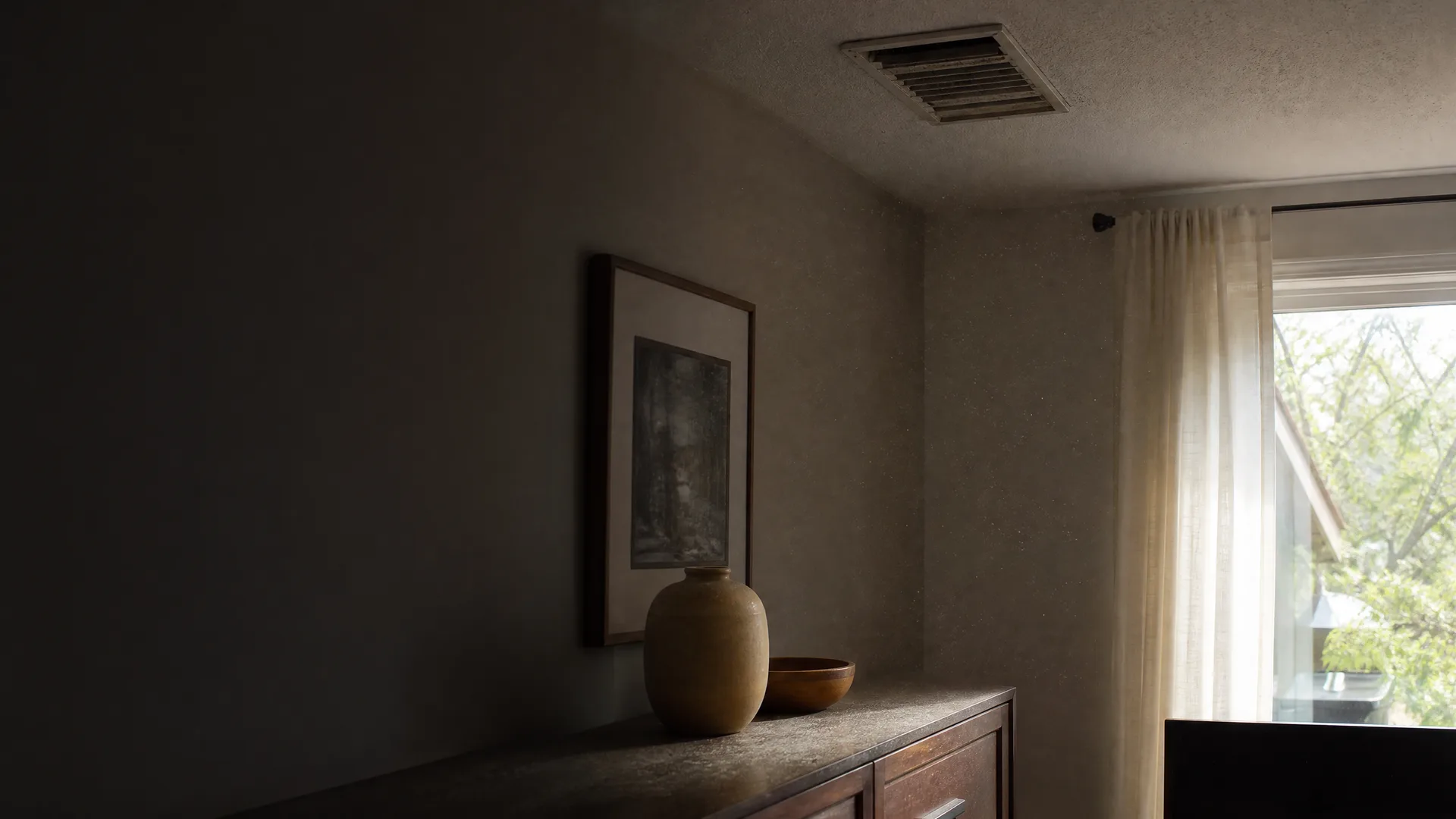
Dim room corner with a framed picture on a textured wall above a counter holding a tall ceramic vase and a shallow wooden bowl, with a sheer curtain beside a window and a ceiling air vent overhead.

The afternoon sun comes in low across the living room and you see it on the ceiling vent, a gray ring of dust around the grille where it meets the drywall. It's one of those warm spring days you opened the windows for, the furnace finally off for the season, and with the light hitting at that angle you notice the same dust sitting on the TV stand and along the top of the picture frames on the wall under the vent. You run a finger along the frame and it comes back gray. The vent hasn't moved air in days. The dust was already there.

Unfinished basement with bare concrete walls and floor, showing exposed wood floor joists overhead with sheet-metal rectangular ductwork, insulated flexible ducts, and pipes.
Metal trunk lines and flex runs feed every room without a buildup anywhere along the way.
Basement ceiling with galvanized sheet metal rectangular ducts and round pipes running between wooden joists above a bare concrete wall and floor.
This is the same kind of network when debris has collected and air has to push through it.

Where that leaves you

  • Duct cleaning in Indiana earns its cost when there's a reason, not on a set schedule.
  • Visible dust at the registers, new allergy trouble, or recent renovation debris are the signs worth acting on.
  • A local contractor who services furnaces and AC systems all year knows what actually collects in Indiana ductwork.
  • Matching with one licensed local contractor means a single point of contact, not a round of competing calls.
  • A system with no symptoms and no recent work behind it usually doesn't need the service at all.
  • Knowing the difference saves you from paying for cleaning you don't need and from skipping it when you do.

So the answer to whether duct cleaning is worth it in Indiana depends on what's actually happening in your house. A system running quiet through another gas heating season and another sticky summer, with nothing showing at the registers, doesn't need it. A system that just went through a renovation, or that's pushing dust into a room where someone's suddenly dealing with allergies, does. That's the whole call, and you're now in a position to make it.

If you land on the side of needing it, who does the work matters as much as whether it gets done. Ductwork varies house to house, and a contractor who's in and out of Indiana homes all year, through furnace season and through the months the AC runs hardest, has seen what collects in a trunk line here and what it takes to clear it. That's different from a crew that doesn't know the climate or the housing stock.

When you request a match through this page, it goes to one licensed local contractor, not a handful of companies competing for your callback. That contractor reaches out to you directly. You're not left sorting through quotes from people who've never seen your system, and you're not stuck waiting on a call that never comes because it got lost in a pile of other bids. One contractor, local, familiar with what Indiana ducts actually deal with. That's the match.

A wooden front door with six small glass panes and a narrow sidelight, set in a shingled house entry with white trim, reached by stone steps flanked by a planted urn with purple flowers and leafy branches in the foreground.
Exterior corner of a house with beige horizontal lap siding and a black-framed window, with white hydrangeas, ornamental grasses and low plantings along a flagstone patio.
Corner of a house with tan lap siding and a window, a brick step edge, flowering white hydrangeas and green shrubs beside a flagstone walkway leading to a white picket fence and a tree in backlit sunlight.
House exterior with cream horizontal lap siding, a dark-framed window, a black wall lantern beside a wood door, potted shrubs on stone steps, and white and pink hydrangeas in the foreground garden.
Corner of a cream lap-sided house with a white-framed window and dark shingled roof, beside a white-flowering hydrangea shrub, a clipped hedge, mulched bed and lawn.

A local pro for your ductwork cleaning

Your duct cleaning request goes to one local pro.

Match me with a pro

There's no charge for the request.