Get matched with someone who does this kind of work in Marion County.
You noticed it when the air handler kicked on. A musty smell moving through the house, or a dark ring around a supply vent, or a stale note in a room that used to smell fine. Indianapolis summers sit heavy and wet, and a duct system that stays damp long enough can grow mold where you can't see it, past the register and back into the metal.
You can't fix this from the vent cover. Seeing it means it's already inside the duct, and checking how far it's spread, where the moisture is getting in, and whether it's just the ducts or the coil and drain pan too, takes someone who can open the system up and look.
That's the part a contractor sorts out, and it's also the part you'd otherwise spend an afternoon on yourself: calling two or three duct cleaning companies, describing the smell and the vent stains to each one, waiting on quotes, trying to tell from a phone call who actually knows what they're looking at. This page skips that. Answer a few questions about your house and what you're seeing, and a contractor who handles mold in ductwork in the Indianapolis area gets in touch with you directly.
No promise here about what they'll find or what it takes to clear it out. Every house holds its moisture differently, and every duct system is run a little differently behind the walls. What this gets you is past the searching and into a conversation with someone who can actually look at yours.
Below, what's worth knowing before that call: what causes mold in ducts, what it means for the air moving through your home, and what to ask when a contractor gets there.
Is there actually mold in my air ducts, or just a musty smell?
A musty smell from the vents doesn't always mean mold has taken hold inside the ductwork. It can also come from a dirty coil, a damp drain pan, or dust that's been sitting in the system a while. The only way to know for sure is to look, and that usually means someone opening the ducts or running a camera through them.
The smell alone doesn't prove it, but it's reason enough to check
A musty smell can come from mold growing on the inside of the ducts, but it can also come from a wet evaporator coil, a clogged condensate drain, or dust that has absorbed moisture over time. Indianapolis summers run humid, and any of these can turn damp inside a duct system that doesn't dry out between cycles. The smell tells you something is holding moisture somewhere in the system. It doesn't tell you where. A dark ring around a vent is a stronger sign, since that's usually residue, not just odor. Past that, telling mold from mildew-smelling dust takes an inspection, not a guess from the next room.
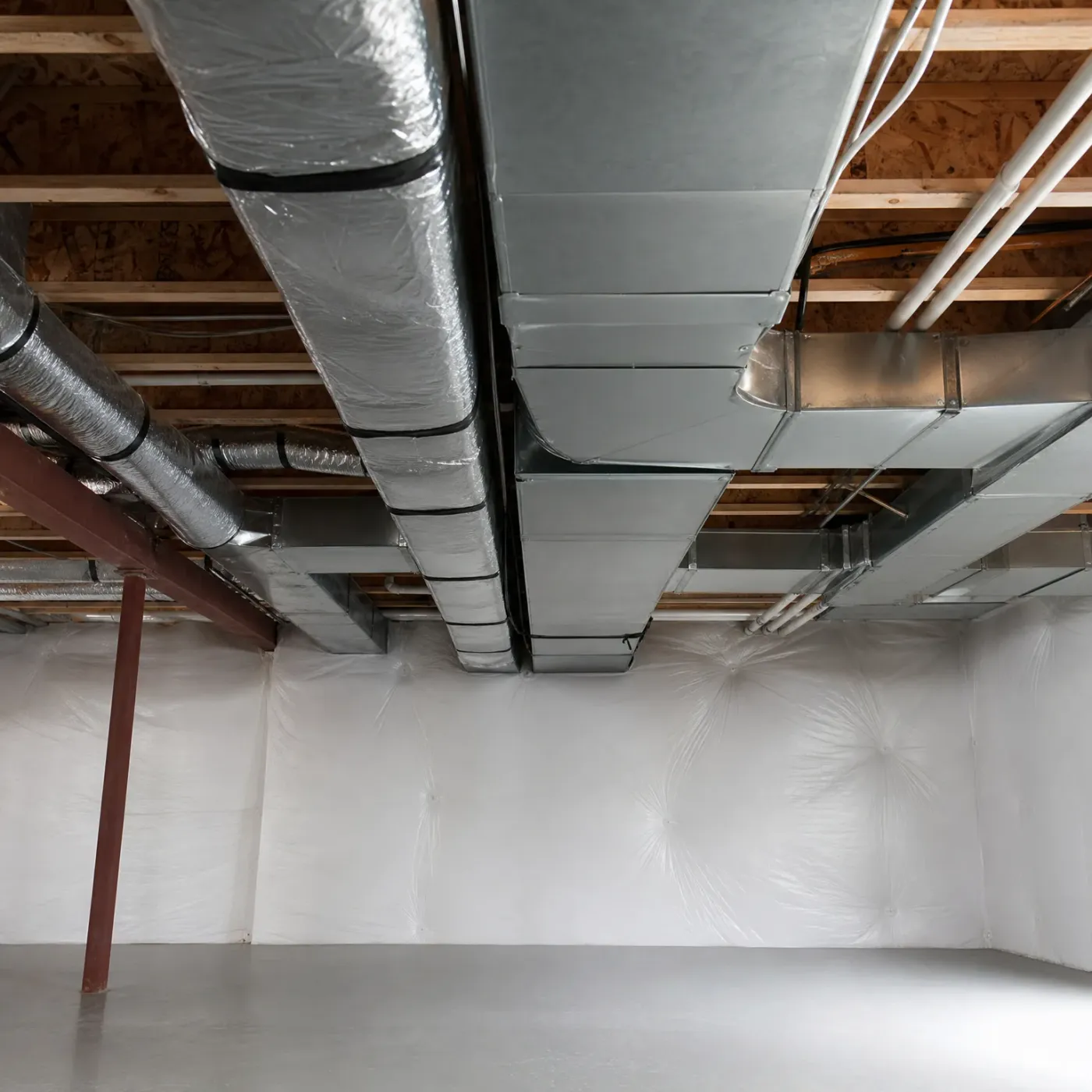
Ducts running clean
This is what a dry system looks like. Metal trunk lines and flex runs stay tight between the joists, the plastic sheeting on the walls keeps basement moisture off the ducts, and air moves through without picking up anything it shouldn't.
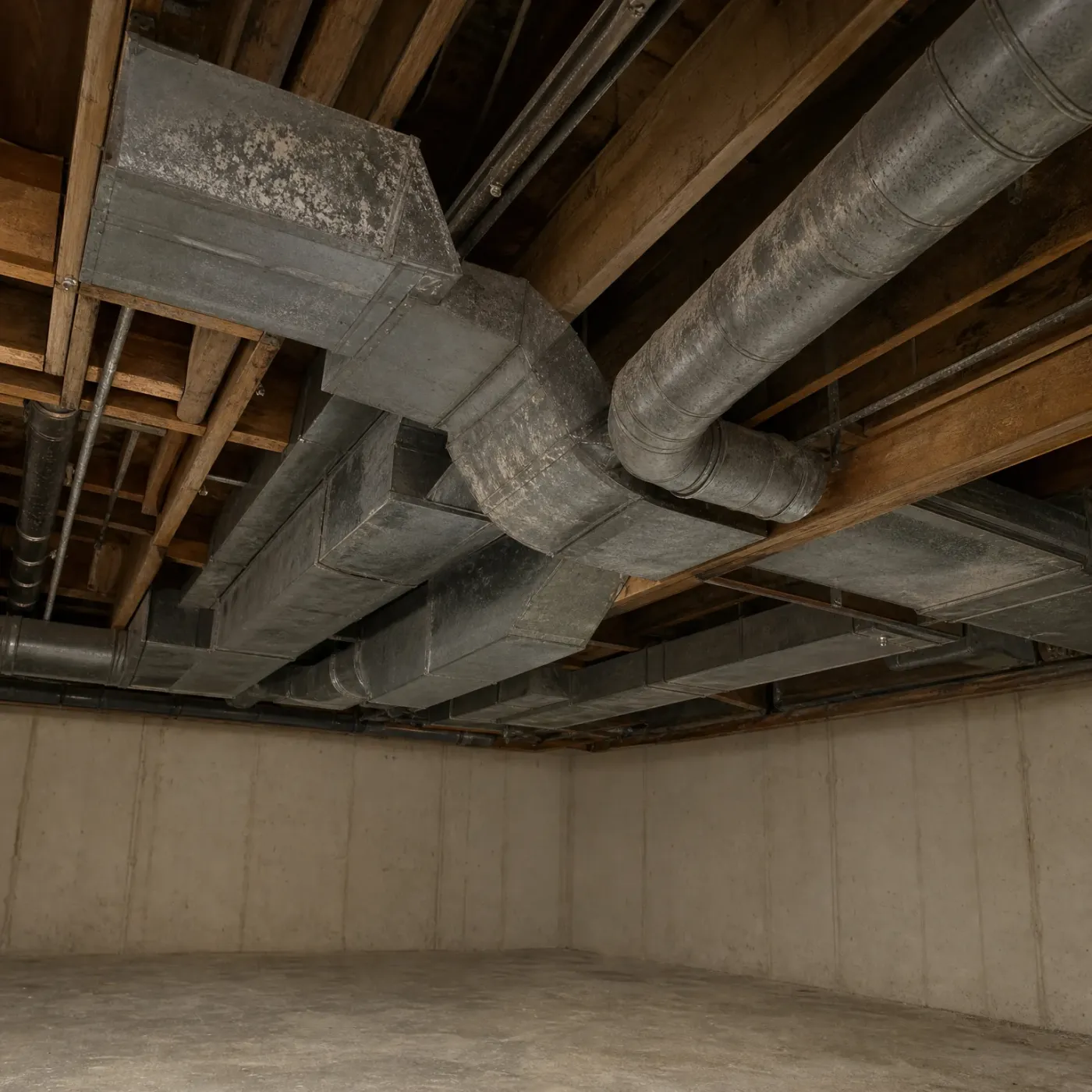
Ducts holding moisture
Here the ducts sit closer to a damp foundation wall, with wiring and joists crowding the runs. A foundation that holds moisture, or a seam that sweats, gives mold what it needs to grow inside the metal where you can't see it.
What is that smell doing to my house
You might notice it strongest in a bedroom with the door kept shut, or in the basement where the return line runs. Family members with allergies or asthma may seem worse when the system runs and better when it's off, or worse in one room than another. Dust on furniture comes back fast after cleaning, with a gray film instead of the usual kind. Some households just notice they don't want to have people over, because the house doesn't smell like it used to. Left alone, a damp duct system keeps feeding whatever is growing in there every time the blower turns on, and it doesn't clear up on its own.
It's April, and the afternoon sun is coming through the living room window. You're on the couch and you look up at the ceiling vent, the one that's always run a little loud. There's a gray ring of dust around the grille, thicker than you remembered, and when you run a finger along the top of the picture frame on the wall below it, it comes away dusty too. The air handler clicks on and you catch it again, that same flat, musty note from before. You've been meaning to look into it since the weather turned warm and the system started running more. You still haven't called anyone about it.
Get matched with a duct system pro in Marion County
Skip searching for someone who cleans ducts in Marion County.
No charge to send it. You decide if you hire them.
How mold actually spreads in ductwork
Mold needs a food source, and the dust and skin cells that settle in ductwork give it plenty to grow on.
Spores travel through the whole trunk line once they take hold, so a patch near one vent rarely stays isolated.
A musty smell gets stronger right after the AC cycles on, because that's when air is moving across the damp spot fastest.
Mold on sheet metal duct usually sits on the surface, while mold inside flex duct insulation can sit deeper and resist a simple wipe-down.
A return line that runs through a damp basement picks up moisture before the air ever reaches the furnace or coil.
Condensation on a coil that drains poorly keeps the nearby ductwork wet long after the system shuts off.
Mold doesn't need much to get started. Dust, skin cells, the fine debris that settles inside every duct system over time, that's enough food for it. All it needs after that is moisture, and in a Marion County summer, a duct system that runs warm air through cool, humid basement space has plenty of chances to collect some. Once mold takes hold at one spot, it doesn't stay put. Spores move with the airflow through the trunk line, so a patch that started near one vent can show up near others before long. That's part of why the smell changes depending on when you notice it. Right after the AC kicks on, air is moving fastest across whatever's damp, which is usually when the smell is strongest. Where the mold sits matters too. On sheet metal duct, it tends to sit on the surface, where a contractor can see it and clean it directly. Inside flex duct, it can work into the insulation layer, which sits deeper and doesn't come clean with a simple wipe-down. A return line running through a damp basement adds another angle, since it can pick up moisture before the air ever reaches the furnace or coil. And if that coil drains poorly, condensation keeps the ductwork near it wet well after the system shuts off, which gives mold exactly the setup it needs to keep going.
Why does mold keep coming back in my ducts here
Half the homes here were built by 1973
Half the homes in Marion County were built in 1973 or earlier, so a lot of duct systems have had decades to trap moisture and dust.
Heat runs October through May
Heat runs October through May here, about eight months, so ducts spend most of the year warm and dry between the summers that get them wet.
Cooling runs June through September
Cooling runs June through September, and that's when the coil and ducts stay damp long enough for mold to take hold.
ACS 2020-2024 · NOAA nClimDiv 1991-2020
1
Moisture collects on duct walls where condensation can't dry out
2
Dust and skin cells settling in the duct feed mold once it starts
3
Mold colonizes the damp section and spreads along the trunk line
4
Spores release into the airflow every time the blower runs
Here the metal is dry and the seams are tight, so basement air stays clean between the joists.
Here years of moisture have oxidized the metal, and a duct in this shape is a place mold can take hold.
A proper cleaning job doesn't stop at the vents you can see. A contractor works the entire trunk line and every branch run off it, since mold that got a start near one register usually isn't the only colony in the system. The equipment pulls negative air pressure through the ductwork while it works, so what gets knocked loose goes into the vacuum rather than back into your living room. Grilles and vents come off the wall and get washed on their own, because mold settles into the slats in a way that a cleaned duct behind them won't fix. Before anything gets buttoned back up, a tech checks the coil and drain pan for standing moisture, since a wet coil will seed a clean duct again within weeks. Any gaps found along the trunk line get sealed too, so humid air from the attic or crawlspace stops getting pulled back into the system. Some contractors finish by running a camera through the line, which shows whether the mold stayed on the surface or had already worked into the seams and insulation.
How a real cleaning job works
A duct cleaning job covers the full trunk line and every branch run, not just the grilles you can reach with a vacuum.
Negative air pressure is pulled through the whole system so loosened spores and dust go into the vacuum line instead of back into the rooms.
Vents and grilles are pulled off and washed separately, since mold can sit in the grille slats even after the duct behind it is clean.
A coil that stays wet feeds mold right back into a duct that was just cleaned, so a tech checks for standing moisture before closing the system up.
Sealing any gaps found in the trunk line during the job keeps humid crawlspace or attic air from getting pulled back into the ducts.
A camera run through the line afterward shows whether the mold was on the surface only or had worked into seams and insulation.
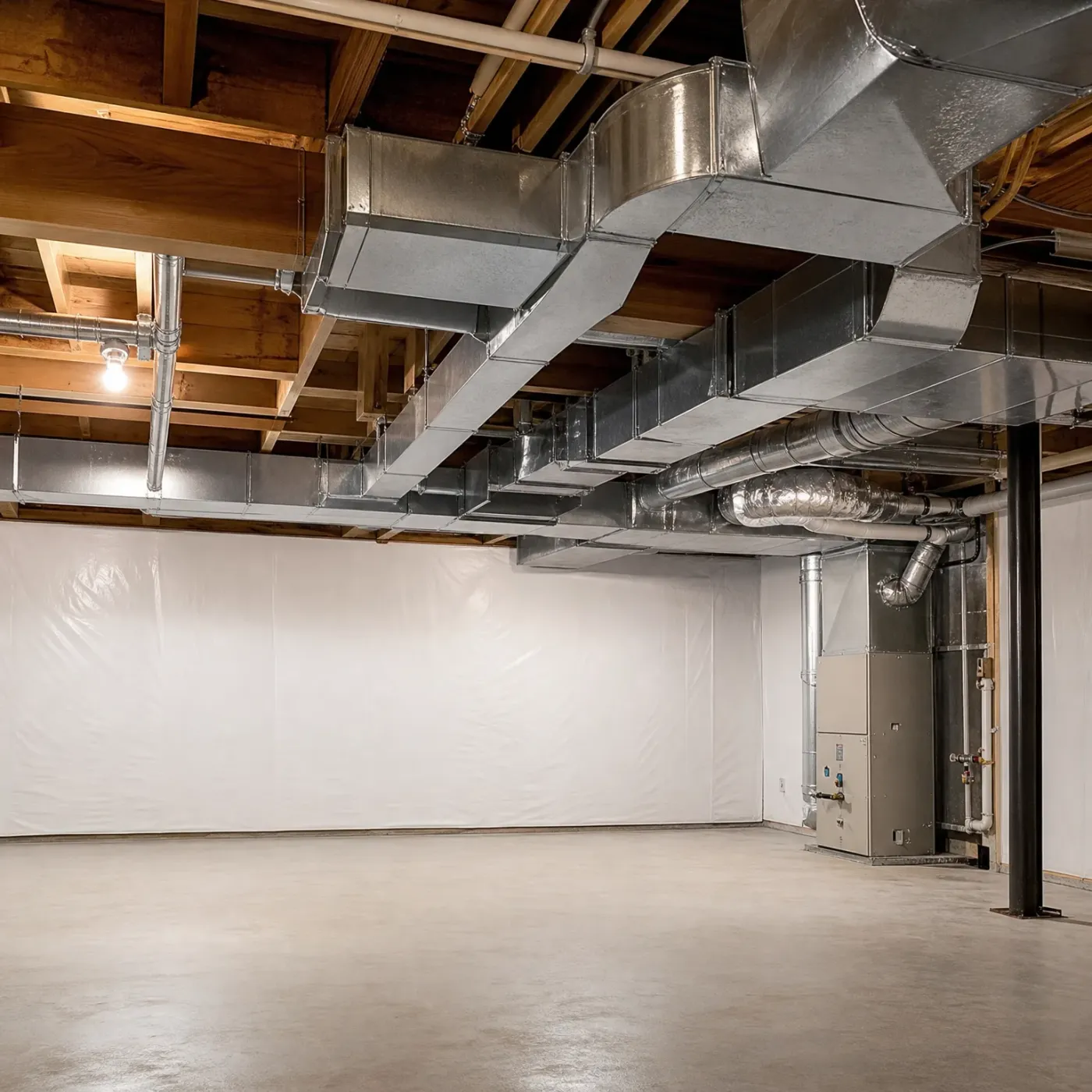
Dry basement ductwork
This is what the trunk line looks like dry. The metal runs tight along the joists, the plastic sheeting on the walls keeps ground moisture off the basement air, and the furnace draws clean air through without picking up anything on the way.
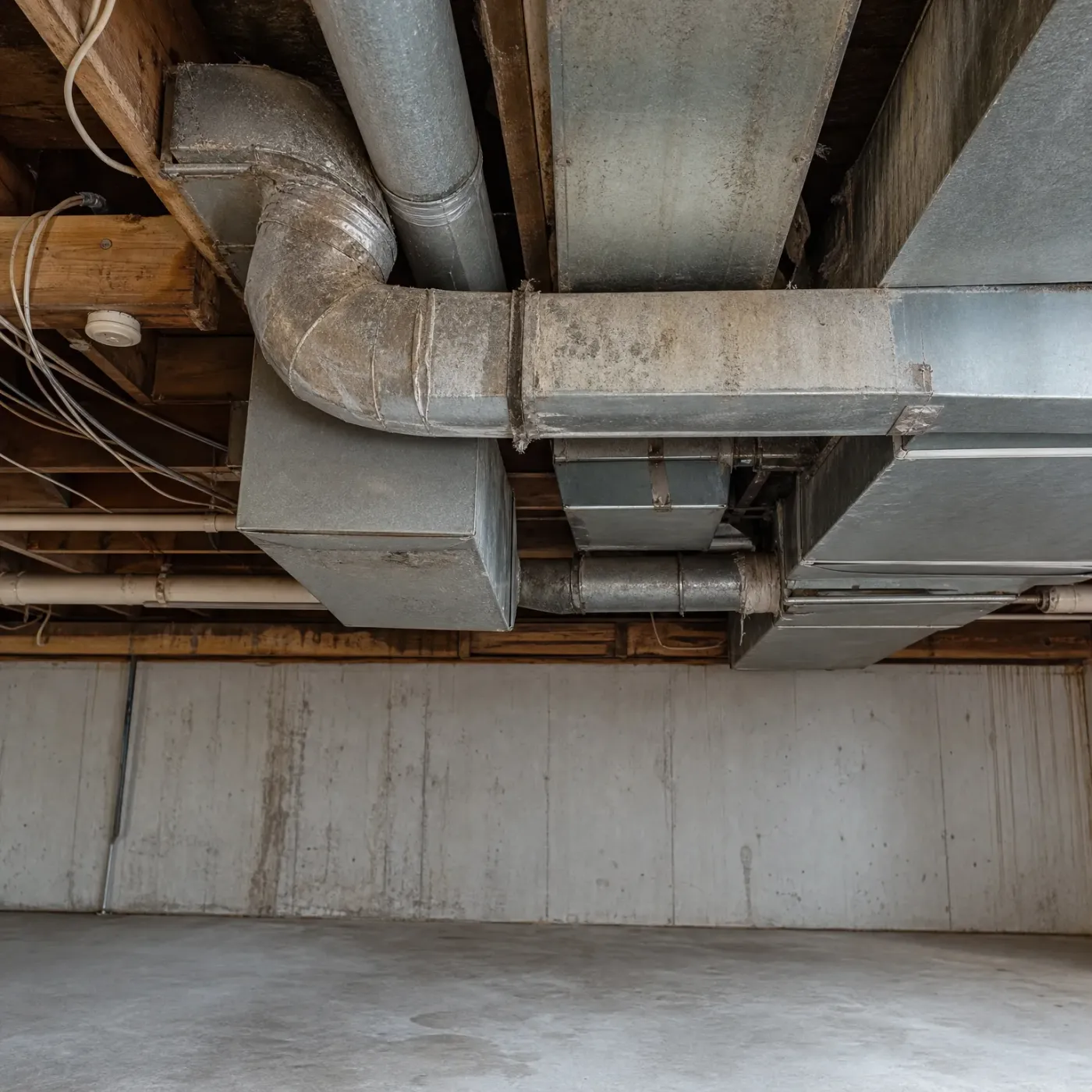
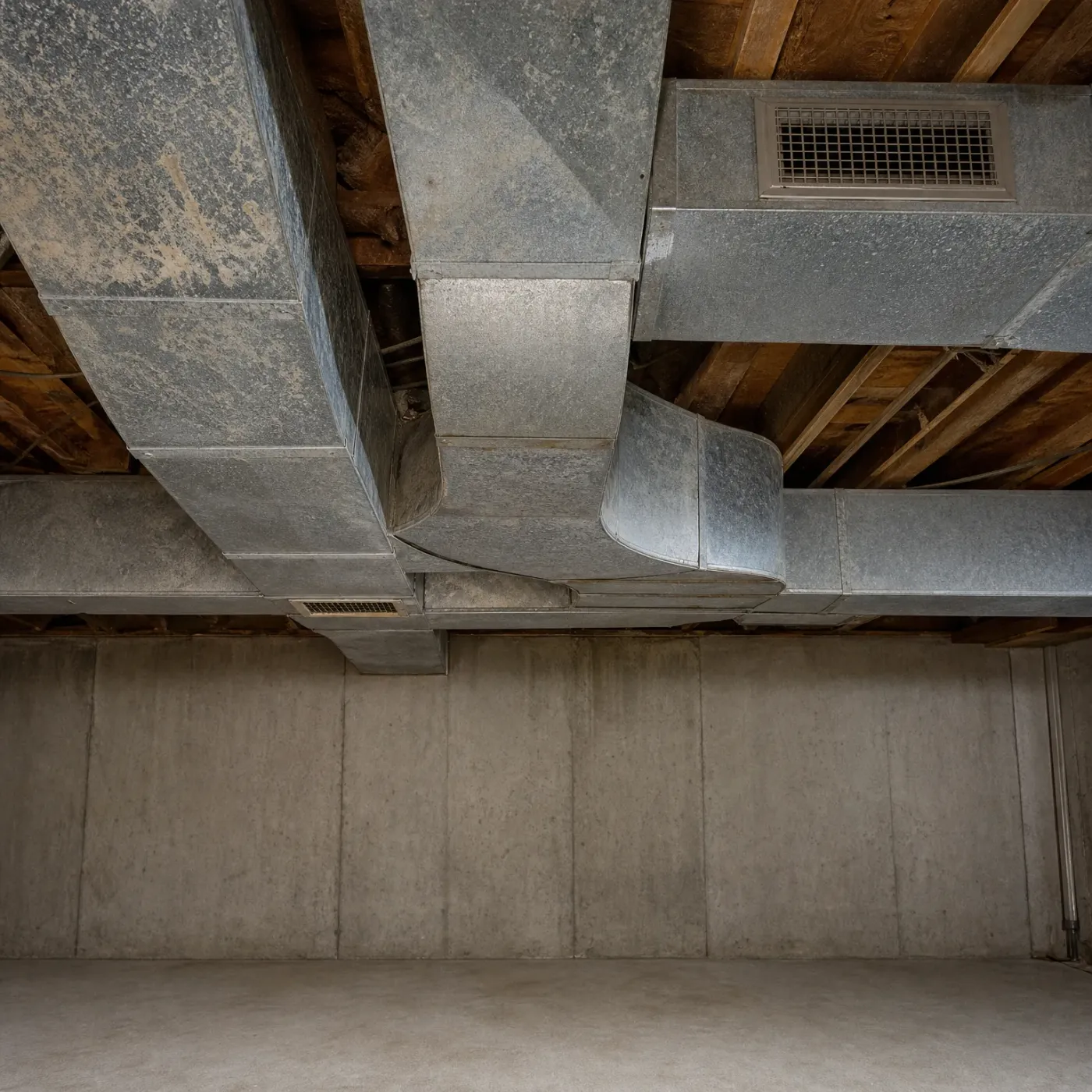
Exposed duct run, bare concrete
No vapor barrier here, just bare concrete walls and floor under the joists. Moisture off the slab reaches the ductwork directly, and the metal at the seams and the two registers you can see has nothing keeping it dry between heating and cooling.
Power here costs 14.77 cents per kilowatt-hour
Clearing out a moldy duct system usually means running the air handler's fan for stretches while the system gets cleaned, and that fan draws power the whole time. At 14.77 cents per kilowatt-hour, that work won't show up as a strange spike on your bill the way it might somewhere with steeper rates.
EIA-861 2025
A musty smell from the vents, a dark ring around a grille, a damp basement where the trunk line runs: that's mold finding what it needs in ductwork that doesn't dry out between Indianapolis summers and the long heating months that follow. It spreads along the trunk line once it starts, and it keeps feeding on the dust already sitting in the system. The fix is a full cleaning of the trunk line and every branch run, not just what a vacuum can reach from a grille. What you don't have to do is figure out which contractor handles that, or call around Marion County explaining the smell and the gray ring over and over, or sort through quotes on your own. Answer a few questions about what you're seeing and smelling, and a contractor who works on duct systems like yours will reach out. You already know something's off in the air. The next step is getting someone out to look at the ducts themselves.
Ductwork Cleaning
Find a duct system cleaning pro in Marion County
Answer a few questions instead of calling shop after shop.