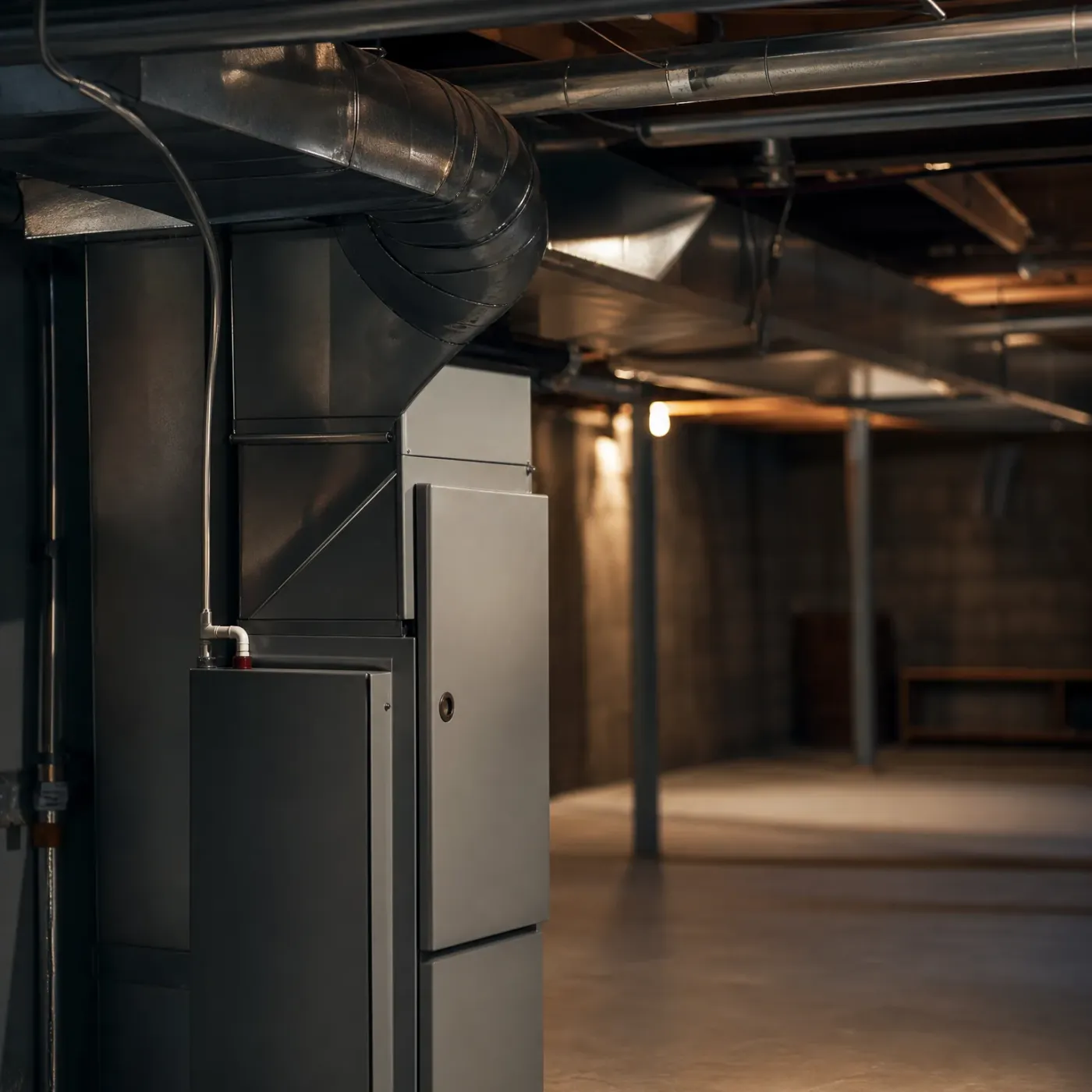




A basement interior with a gray furnace or air handler unit connected to large sheet-metal ductwork running along the exposed joist ceiling, with support posts and a concrete block wall in the dim background.

A local pro for your ductwork cleaning

Musty smell from vents in Fort Wayne, IN

That musty smell from your vents usually points to moisture sitting somewhere in the duct system, not just a dirty filter. Summers get sticky enough around Fort Wayne for that moisture to linger and grow something in there. This page covers what's causing it and what cleaning involves, then connects you with a contractor who can look at your ducts and quote the job, instead of you calling around Allen County to find one.

Connect with a pro

A musty smell from the vents is almost always mold or mildew growing somewhere air passes through, most often in the ductwork itself or on the evaporator coil inside the air handler. Fort Wayne summers run humid enough that the air conditioner pulls a lot of moisture out of the house, and that water has to drain away through a condensate line. If that line is clogged, or if the coil stays wet between cooling cycles, the moisture sits instead of draining, and mold starts on it. Once it's established, every time the system runs it pushes that smell through the house. A dirty filter can add a stale odor, but it won't produce the damp, musty one on its own. The smell matters beyond being unpleasant. Mold growing in a duct system can affect air quality for anyone breathing it, and it tends to spread further the longer it sits.

Why does this smell keep coming back in your home?

  • Half the homes here were built by 1976

    Half the homes in Allen County were built in 1976 or earlier. Older ductwork has had more years to collect the dust and moisture that mold feeds on.

  • Heat runs October through May

    Heat runs here about eight months a year, October through May. That's eight months of air moving through the same ducts without a break.

  • Cooling runs June through August

    Cooling runs June through August, and that's when the coil stays wet longest. A damp coil sitting through a humid Fort Wayne summer is exactly what mold needs.

ACS 2020-2024 · NOAA nClimDiv 1991-2020

You run the AC hard all summer to keep up with the humidity, and every time it cycles on, it pushes air across a coil that's wet more often than it's dry.

A furnace running October through May doesn't dry that moisture out on its own. The blower moves air past the same damp coil and duct surfaces all winter, so the smell doesn't wait for summer to come back.

A gray-haired man in a dark coat with snow on the shoulders and collar stands smiling in a dimly lit entryway with a paneled front door, lamps, and a framed picture in an adjoining room.
A gray-haired, bearded man in a dark winter coat with snow on the shoulders stands in a doorway of a home interior with a lit lamp, framed pictures, a potted plant and a staircase behind him, and an evergreen wreath at the left edge.
An older man with gray hair and a beard, wearing a snow-dusted dark coat and knit scarf, stands smiling in a dimly lit house entry with a lit lamp, mirror, and a living room with snow visible through the window behind him.
A smiling gray-haired man in a dark wool coat with snow flecks stands in a dimly lit home entryway, with a lit table lamp, potted plant, framed pictures and a living room visible behind him.

Where the smell is coming from

Mold needs something to grow on, and the inside of a duct run gives it plenty: a thin layer of dust settled on sheet metal, plus whatever moisture the air conditioner leaves behind as it cycles. Flex duct in a crawlspace or attic holds that moisture longer than hard metal trunk lines do, since it doesn't dry out as fast once the AC shuts off. The smell you notice at the vent started somewhere upstream, often several feet back in a run you can't see or reach without pulling the register off first.


Why a filter change won't fix it

A filter catches particles moving through the airstream. It doesn't touch the duct walls or the coil, and it doesn't do anything about moisture sitting in a bend of ductwork. Homeowners often swap the filter first because it's the one part they can see and reach, then find the smell is still there a week later. If the mold is on the coil or inside the duct run itself, cleaning has to reach those surfaces directly, not just filter the air moving past them.

Empty basement room with bare concrete walls and floor, exposed wooden floor joists overhead, large galvanized sheet-metal ducts with a vent grille, colored pipes, and a single lit bulb.
Before you get your ductwork cleaning
Empty unfinished basement with bare concrete floor, insulated walls with vapor barrier between wood studs, exposed wood joists, galvanized sheet-metal ductwork, a recessed light, and a steel support column.
After you get your ductwork cleaning

Left uncleaned

The smell usually gets stronger as summer goes on, and mold spores circulating through the house can bother anyone with allergies or asthma.

Find a pro near me

Get it cleaned

A contractor who cleans ductwork for a living can tell you what's actually growing in there and clear it out, instead of you guessing from the smell alone.

Find a pro near me

DIY Duct Cleaning vs. Hiring a Pro

Clean it yourself

  • Wiping down the registers and running a vinegar solution through the vent covers reaches maybe the first foot of duct, nowhere near the coil or the main trunk lines.
  • A new filter cuts down on dust feeding the mold but does nothing for moisture already sitting on metal or on the coil itself.
  • Running the fan with the AC off for a while can help dry out a wet coil between cycles, but it won't touch mold that's already growing.
  • Store-bought duct cleaning kits with long brushes can pull debris from a few feet of straight duct but can't reach bends, branches, or the return plenum.
  • The smell typically comes back within weeks because the moisture source and the mold colony are still there, just hidden further down the line.
  • Without a camera or real access to the system, there's no way to check whether the coil, the drain pan, or the ductwork itself is the actual source.

Get it cleaned professionally

  • A contractor brings equipment that reaches the full duct run, including bends and branches a homeowner can't get a brush into.
  • Negative air pressure tools pull loosened dust and mold out of the system instead of just stirring it around inside the ducts.
  • A contractor can inspect the evaporator coil and drain pan directly, since that's one of the most common places moisture collects unseen.
  • Cleaning the whole system at once addresses the dust and the mold together, rather than treating the smell one register at a time.
  • A contractor who does this work regularly can point out if something else, like a disconnected duct or a slow drain, is adding to the moisture problem.
  • Skips the back and forth of researching which tool or product might work and just gets someone qualified to look at the actual system.
Unfinished basement with bare concrete floor and walls, exposed wood joists, large galvanized sheet-metal ductwork, PVC and copper piping, and a gray furnace unit beside wood stud framing.

Ductwork running clean

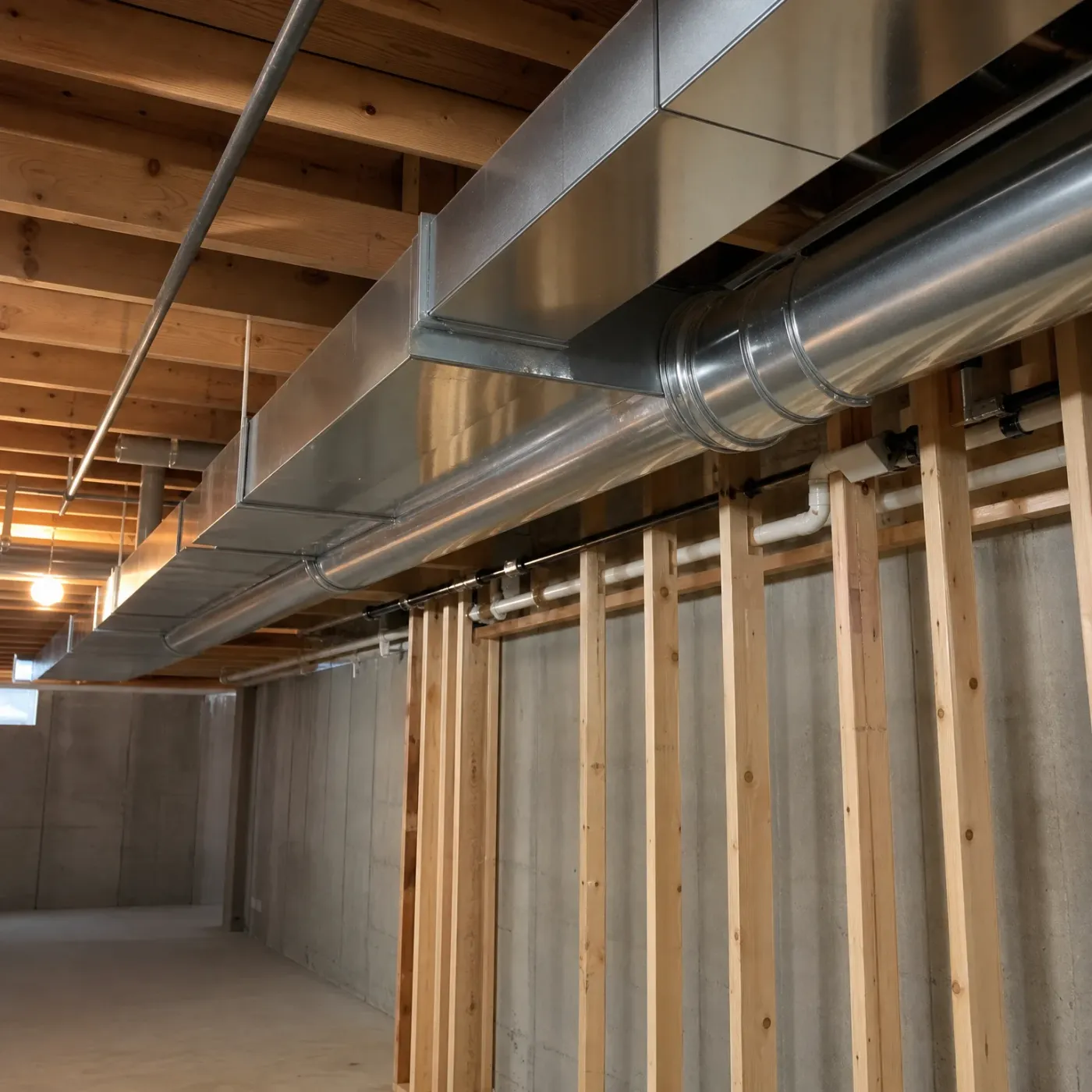
This is what a duct system looks like when air moves through it the way it should. The furnace sits connected to metal trunk lines overhead, and air passes through without picking up anything it shouldn't. No standing moisture, no dust built up thick enough to hold it.

Basement ceiling with large galvanized sheet-metal ductwork, round metal pipes and plumbing lines running beneath wood joists, above a bare concrete wall and floor.

Ductwork holding moisture

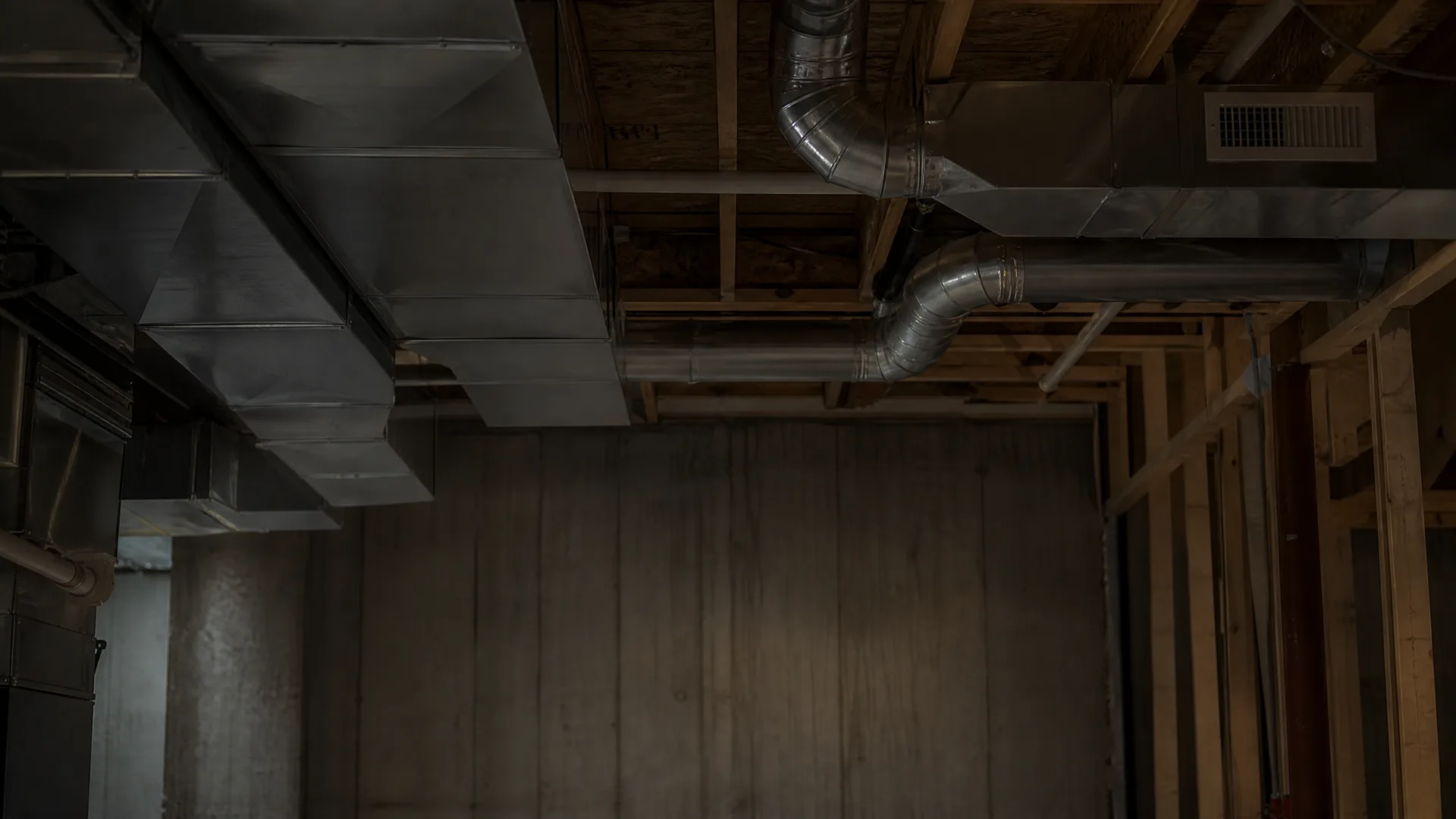
Water staining on the foundation wall behind these joists means moisture has been sitting nearby, and duct seams in a basement like this can draw it in. Once that moisture settles on dust inside the metal, mold has what it needs to keep growing every time the air handler cycles.

A woman wrapped in a thick cream knit blanket sits in a chair with an open book on her lap, beside a lit table lamp and a frost-covered window at night.
An older woman with grey-blonde hair in an updo and a beige turtleneck sweater smiles while looking to the side in a warmly lit kitchen, with a round loaf of bread on the counter in front of her and a dark window showing snow outside.
Unfinished basement with exposed wood joists, galvanized rectangular and round ductwork, piping, stud framing against concrete walls, and a bare hanging light bulb.

A pro who works on ducts

Answer a few questions about the duct cleaning and skip the search.

Your request goes to an Allen County pro who takes ductwork jobs.

Get my match

Asking costs nothing, and the choice to hire stays yours.

Empty basement with bare concrete walls and floor, a small window at left, and exposed wood joists with galvanized sheet metal ductwork and pipes overhead.
Metal trunk lines and flex runs sit clean and dry above the concrete walls, with no buildup anywhere air would pass through.
Dusty sheet-metal HVAC ducts with a rectangular vent register run beneath wooden floor joists above an empty concrete-walled basement.
Dark grime coats the duct exterior here, and that same layer lines the inside where the air actually moves.

Does the smell mean mold is actually growing inside the ducts?

You keep catching that musty smell every time the air kicks on, and it makes you wonder if there's actual mold sitting inside your ducts right now, not just a stale odor that'll air out. It's a fair question. The smell alone doesn't tell you how bad it is or exactly where it's growing, just that something back there is feeding on moisture.

If you can smell it, something is already growing

Mold doesn't need much to take hold, just dust for food and moisture it gets every time the coil sweats during a Fort Wayne summer. The smell you're noticing is the mold itself giving off a musty odor as it grows, not a side effect you could get without it. It might be a thin patch on the evaporator coil or a longer stretch of buildup down a duct run, and there's no way to tell which from the smell alone. A contractor who cleans ductwork can open the system up and show you where it's growing and how far it's spread, which is the only way to know for sure what you're dealing with.

A ceiling air vent in a living room with beige walls, a table lamp and potted plant on a wooden console, a sofa with a blue cushion, and a window showing green trees outside.

Spring finally warms up enough that you shut the furnace off for the year, and you're in the living room with the windows cracked when you notice it again, that musty smell drifting down from the ceiling vent. You get a chair and look up at the grille. A layer of dust has built up across the slats, thick enough that you can see it from the floor once you know to look. Some of it has settled on the bookshelf underneath and along the top of the TV. You run a finger along the vent cover and it comes away gray. The furnace hasn't run in weeks, but the smell is still there every time the blower kicks on for the air conditioner, like it never really left with the cold weather.

Power here costs 16.78 cents per kilowatt-hour

At 16.78 cents per kilowatt-hour, running the blower longer to chase a musty smell adds up fast. A duct system caked with dust and mold makes the furnace or AC work harder to push air through, and that extra runtime shows up on next month's bill.

EIA-861 2025

A basement with a gray furnace on a concrete pad connected to large sheet-metal ducts running along an exposed wood joist ceiling, with PVC pipes and plastic sheeting on the walls.

Ductwork running clean

The furnace sits connected to metal trunk lines overhead, with flex and rigid duct running across the joists. Air moves through that whole path without picking up anything it shouldn't, and nothing in the basement points to standing moisture.

Galvanized sheet metal HVAC ductwork with a vent grille running along a wooden joist ceiling above a bare concrete wall.

Ductwork in trouble

The sheet-metal trunk lines branch out under the floor with a register cut into one run. Dust and whatever moisture the coil sheds settle inside that metal where you can't see it, right where the air keeps passing through.

A smiling man in an olive T-shirt and jeans stands in an open front doorway holding the door, facing a person in a navy polo and cap seen from behind in the foreground, with horizontal wood-look siding and a potted white flowering plant nearby.

A musty smell from the vents has a cause you can find

The smell isn't something to live with or mask with a candle. It's mold or mildew sitting somewhere in the duct system, usually the ductwork itself or the evaporator coil, and it's there because Fort Wayne summers push enough moisture through that system to feed it. That's the whole answer. Wiping down registers or swapping the filter might help a little at the edges, but neither one reaches the coil or the trunk lines where the smell is actually coming from.

Finding out what's growing in there and getting it cleaned out takes someone who does this work, not a weekend with a shop vac. Instead of calling around Allen County to find a contractor who handles duct cleaning, checking who's licensed, and explaining the same musty smell over and over on the phone, you can get matched with a contractor who handles this and let them reach out to you. From there you're talking to someone who already knows what you're dealing with.

Living room interior with a light sofa holding a dark green cushion and a brown knit throw, a tall leafy plant by a black-framed window, a wooden coffee table with a round tray, and wooden shelves holding vases and books.
Dimly lit unfinished interior ceiling with galvanized rectangular and round sheet-metal ducts, a wall vent grille, exposed wood framing and joists.

Get your ductwork to the right pro

Answer a few questions instead of calling shop after shop.

Duct and vent cleaningDucts or ventsAllen County, IN
Step 1 of 2

What ZIP code is the job in?