Mini Split Installation in Greenfield, IN
A new system here will heat from October through May and cool from June through August every year. Tell us about the house, and a licensed contractor who covers Hancock County will get in touch.
Tell us about the job
It takes about a minute.
Greenfield asks a mini-split to work almost year round
Winter nights here average 23°F from December through February, and a mini-split has to keep pulling heat from that cold air the whole stretch from October through May. Summer afternoons average 83°F, so the same unit switches over and runs the other direction from June through August. That's 11 months of the year with the system doing one job or the other.
A unit built for this needs to hold up on both ends. Any ductless mini-split heat pump made on or after January 1, 2023 has to meet 14.3 SEER2 for cooling and 7.5 HSPF2 for heating, the same federal minimums as any other split-system heat pump. Worth asking about when you're comparing units for a house that leans on one this many months a year.
- 8 months
- October through May, your system heats
- 3 months
- June through August, it cools
- 23°F
- the average winter night it heats against
- 83°F
- the average summer afternoon it cools against
NOAA nClimDiv, 1991–2020 normals
In Indiana, HVAC licensing for homes is left to the counties and cities.
Hancock County sets its own rule for HVAC contractors, since Indiana leaves that to the counties and cities. There is no state license or state record to check here. Whatever a contractor can show you, license, registration, or nothing at all, comes from the county or a city government, not from Indiana.
For this mini-split, the protection that follows is a permit. Installing a mini-split usually means pulling a permit from the local building office and having the finished work inspected. That inspection is what checks the electrical connections and the refrigerant lines are done right, since nobody at the state level is checking any of it.
Sources: Indiana Department of Workforce Development · State of Indiana
- Is a mini split worth it?
- For most homes here, yes, especially if you're heating a room or addition that your main system doesn't reach well. A mini split handles both heating and cooling in one unit, and it can hold up down to the kind of cold this area sees in January and February. If your home already heats with gas and just needs help in one or two rooms, a mini split can cover that without touching the ductwork. A contractor can look at your layout and tell you where it fits and where it doesn't.
- How many rooms can a mini split cover?
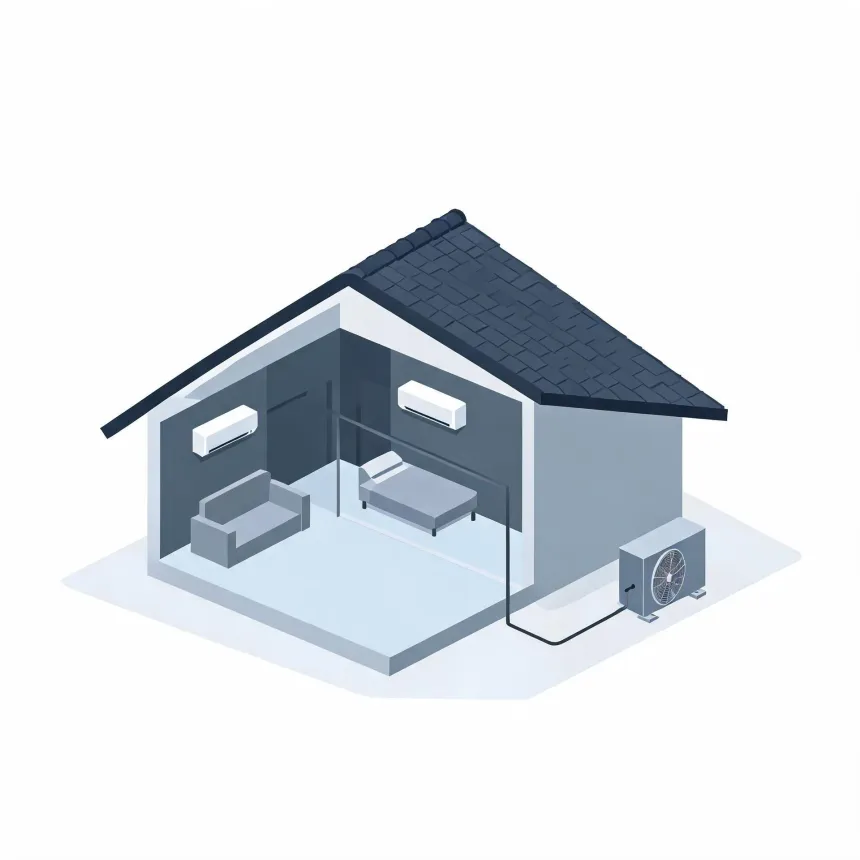
- A single indoor unit is built for one room or one open space. If you need to cover several rooms, a multi-zone system lets one outdoor unit run two, three, or more indoor heads, each with its own thermostat. How many zones make sense depends on the size and layout of the rooms, so a contractor should walk the house before you settle on a number.
- Can a mini split heat a whole house?
- It can, but it takes the right setup. A multi-zone mini split with an indoor head in each main room can heat an entire house, and modern units are rated to keep working in cold well below freezing, which matters here with winter lows averaging 23°F. Whether one system covers your whole house depends on the square footage and how the rooms are arranged, so that call is best made by a contractor who's seen the house.