Mini Split Installation in Evansville, IN
A new system here will heat from October through April and cool from May through September every year. Tell us about the house, and a licensed contractor who covers Vanderburgh County will get in touch.
Tell us about the job
It takes about a minute.
What a mini-split in Vanderburgh County has to handle
Your mini-split works almost all year here. Heat from October through April, cooling from May through September, just a few weeks in between when it gets to rest. Winter nights average 27°F, so it has to hold its heating output at that temperature, not just on a mild fall evening. Summer afternoons average 87°F, and the compressor has to work hard against that too.
Any mini-split installed new has to meet 14.3 SEER2 for cooling and 7.5 HSPF2 for heating. That is the federal minimum for split-system heat pumps, not a target to aim for, so it is worth asking what you are actually getting. Indiana saw 103 damaging wind events and 11 winter storms over the past ten years, and 17% of households in the state lost power for at least a day in 2024. A mini-split has no pilot light to relight and no ducts to worry about, but it does need power to run, so how it comes back on after an outage is worth asking about before it goes in.
- 7 months
- October through April, your system heats
- 5 months
- May through September, it cools
- 27°F
- the average winter night it heats against
- 87°F
- the average summer afternoon it cools against
NOAA nClimDiv, 1991–2020 normals
In Indiana, HVAC licensing for homes is left to the counties and cities.
Vanderburgh County sets its own rule on who can do HVAC work, since Indiana leaves that to the counties and cities instead of running a state license. That means there's no state exam or state record to check for a contractor working here. Whatever standard applies comes from the county or the city where the house sits, not from Indianapolis.
For a mini-split installation, the protection that does apply is the local building office. In most cities and counties, putting in a mini-split needs a permit and an inspection once the work is finished, and that inspection is what confirms the line set, the electrical hookup and the mounting were done right. That inspection is the record this job gets, in place of a state license.
Sources: Indiana Department of Workforce Development · State of Indiana
- Is a mini split worth it?
- For the right room or addition, yes. A mini split heats and cools without ductwork, so it works well for a converted garage, a bonus room, or an addition where running ducts is not practical. Evansville homes need heat or cooling most of the year, seven months of heat and five of cooling, so a unit that handles both jobs earns its keep. Where it makes less sense is as a replacement for a central system that already works fine.
- How many rooms can a mini split cover?
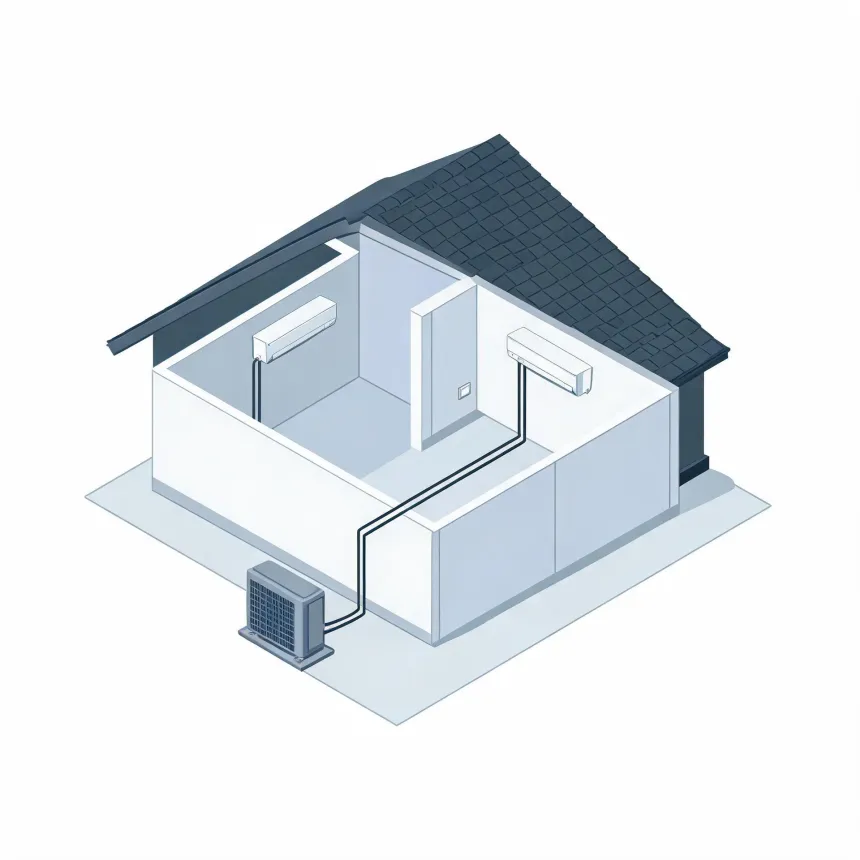
- One outdoor unit can run several indoor heads, each serving its own room or open area. This is called a multi-zone system, and each indoor head has its own thermostat, so you can heat or cool one room without running the others. A contractor sizes the outdoor unit and the number of heads to the rooms you want covered, since the load depends on each room's size and layout.
- Can a mini split heat a whole house?
- It can, if it is sized and placed for that from the start. A multi-zone system with a head in each room can heat and cool an entire house, and mini splits are heat pumps, so they do both jobs with one system. Winter nights here average 27°F, so the outdoor unit has to be rated to keep working at that temperature, which is worth checking before you count on it as your only heat source. A contractor can work out whether whole-house coverage fits your home's layout or whether it makes more sense alongside your existing system.