
Humidity above 60 percent
Indoor air much past 60 percent humidity gives mold what it needs to grow on duct surfaces, and Carmel summers push a house there without a working AC and dehumidifier.
Get matched with a pro who works on ducts in Hamilton County.
Match me with a proYou saw something dark around a vent cover or caught a musty smell when the furnace kicks on, and now you're wondering if it's actually mold growing inside the ductwork itself, not just dust. With Hamilton County summers as sticky as they are, the air moving through those ducts carries a lot of moisture, and that makes the question worth taking seriously before you call anyone out.
Mold needs moisture, a food source and a surface to sit on, and ductwork can offer all three. Condensation forms on duct surfaces when humid air meets a cool metal or fiberglass lining, especially near the evaporator coil where cooling happens. Dust sitting in that moisture gives mold enough to feed on. In Hamilton County, where summers get sticky for months at a time, that moisture shows up every time the air conditioner runs. Once mold takes hold inside the ducts, every cycle of the system pushes spores into the rooms you breathe in. A musty smell when the air handler turns on, or dark spots around vent covers, are usually the first signs something is growing where you can't see it.


Mold needs standing moisture to get started, and most of a duct system never sees it. When it shows up, there's usually a reason you can trace. A clogged condensate drain near the evaporator coil will keep that stretch of duct wet long after the AC shuts off. Runs that pass through a crawlspace do something different: humid air meets cold metal and sweats, and that happens more through a Hamilton County summer than people expect. A plenum seam that's come loose or a disconnected run can draw in damp air from outside the conditioned space entirely, and that's often enough on its own. Once there's enough moisture, mold doesn't need bare metal. It grows on the dust already sitting inside the duct, which is part of why cleaning it out matters. One thing worth knowing if you're trying to figure out where it's coming from: if the musty smell gets stronger the moment the system kicks on, the growth is probably sitting upstream of the blower, not somewhere past it.


Indoor air much past 60 percent humidity gives mold what it needs to grow on duct surfaces, and Carmel summers push a house there without a working AC and dehumidifier.
You get matched with a licensed contractor local to Hamilton County who deals with this in ducts every summer, and only that one contractor calls you.
Half the homes here were built by 2001
Half the homes here were built by 2001, so half have ductwork that old too. Older runs are more likely to have a seam that's loosened or insulation that's worn thin, either of which lets moisture in.
Heat runs October through May
Heat runs eight months a year here, October through May. The furnace's long runtime means any duct that's gathering spores has months of warm, moving air to spread them through the house.
Cooling runs June through August
Cooling runs June through August. That's when the evaporator coil is making condensate, and it's the dampest stretch of the year for the ductwork tied to it.
ACS 2020-2024 · NOAA nClimDiv 1991-2020
Mold inside your ducts does not stay there. Every time the system cycles, it moves air, and whatever is growing in that ductwork moves with it. You might catch it first as a smell, a musty note that's stronger right after the furnace or AC shuts off. That smell is a sign the air moving through your house is carrying something with it, not just warming or cooling it. Spores land on the surfaces air passes over most, so a bedroom or living room with a strong supply vent collects more than a room with poor airflow. If someone in the house has asthma or allergies, or if you've got young kids or older adults at home, they're often the first to notice something is off, even before you smell it yourself. A dark patch around a return vent or on the furnace cabinet itself is worth taking seriously. By the time you can see it, the growth has usually moved beyond that one visible spot into the ductwork you can't see. One thing worth knowing for a Carmel summer: cutting back on the AC to hold down the bill lets indoor humidity climb, and that's the one condition mold needs most. Running the system less can end up feeding the exact problem you're trying to avoid.






A duct system with mold in it does not clear up on its own. The spores keep cycling through the house every time the furnace or AC runs, and in a Carmel winter or a muggy Hamilton County summer that means most hours of the day. Someone who cleans ducts for a living in this county has seen what a leaky seam near the coil or a damp basement run does over a few seasons, and knows where to look first instead of guessing. That matters more than finding just anyone to come out. Getting matched means one local contractor takes on your situation, not a handful of trucks competing for the job. You describe what you're seeing, the musty smell, the dark ring around the vent, and they come at it already knowing what tends to cause it in houses like yours. From there it's their call on what the duct work actually needs.

A musty smell with no visible growth usually means the mold is further back in the duct run, past where the vent cover lets you look. It could be sitting on the inside of a return duct, inside the furnace cabinet, or right at the coil. A contractor who services ducts in Hamilton County every season can get a camera or a mirror into those sections and tell you what's actually growing and where, instead of guessing from a smell.

Dark spots around a vent cover or on the grille itself are easier to deal with because you already know where to look. That doesn't mean the problem stops there. Visible growth at one vent often means spores have already traveled through connected ductwork, so cleaning just that one register doesn't solve it. It tells you where to start, not where to stop.

A musty smell that comes and goes with the furnace isn't something to wait out. Every cycle pushes that air through the rooms you sleep and eat in, and if anyone in the house has allergies or asthma, you've probably already noticed symptoms that ease up when they're away from home. That's not a coincidence. It's the house telling you where the problem is.
Hamilton County summers run humid enough that a duct system with a hidden moisture source keeps feeding mold all season, not just on the worst weeks. A contractor who services this equipment locally knows where that moisture tends to start, whether it's a condensate line near the coil or a duct run through a crawlspace, and can look at the spots a vent cover won't show you. You'd be matched with one contractor who takes on your specific situation, not a handful of companies working off the same generic checklist.

At 14.96 cents per kilowatt-hour, running a dehumidifier or extra fan to dry out a damp duct run doesn't carry a steep penalty on the power bill. That makes it worth keeping humidity down as a habit, not just a fix after mold's already found somewhere to grow.
EIA-861 2025

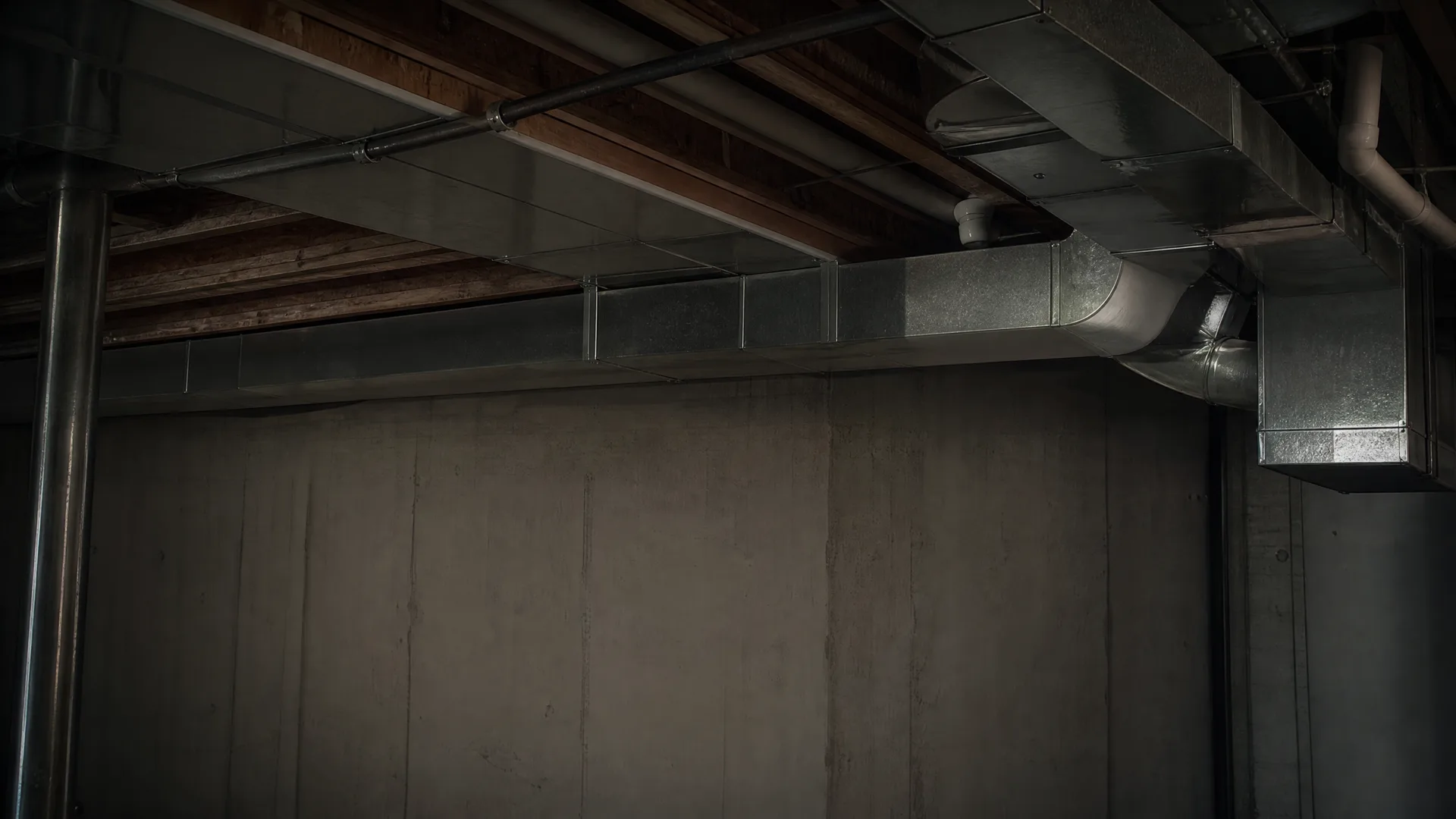
This is what a clean basement duct run looks like: bare metal, dry joists, no staining. Air moves through without picking up anything it shouldn't. The copper and PVC nearby stay dry too, which means no stray moisture is feeding anything growing on the sheet metal.

Same kind of basement, same metal ductwork, but something nearby has kept it damp long enough for mold to take hold. It might be a drain line sweating next to the duct or a joint that's let moisture in. You won't always see it from below. Often you smell it first.
Mold in a duct run doesn't go away because you ran the furnace less this week or cracked a window. It stays until someone gets into the ducts, finds the wet section, and cleans it out. A musty smell that comes back every winter, or gets worse every muggy stretch through summer, is the system telling you where to look. Getting matched means one licensed contractor who works on Hamilton County duct systems all year, in homes with the same basement runs and the same condensate lines as yours, reaching out to look at your ducts specifically rather than sending a crew that handles whatever job is next on the list. You're not fielding calls from five different companies trying to win your business. You're hearing from the one who's going to actually look at your ductwork, tell you what they find, and what it would take to get it clean and dry again.
Your request stays with one local pro.