
Mini Split Installation in Zionsville, IN
A new system here will heat from October through May and cool from June through August every year. Tell us about the house, and a licensed contractor who covers Boone County will get in touch.
Tell us about the job
It takes about a minute.
What a mini-split in Zionsville has to handle
Boone County needs heat or cooling 11 months out of the year. Winter nights average 21°F from December through February, and a mini-split heat pump has to keep pulling warmth out of air that cold for the October through May stretch when homes here need heat. Summer afternoons averaging 82°F ask less of it, but that side of the job still runs June through August.
Any mini-split installed new has to meet the federal minimum for a split-system heat pump, 14.3 SEER2 for cooling and 7.5 HSPF2 for heating. That is the floor, not a feature, so it is worth knowing when you compare quotes. Indiana also sees its share of outages, 17% of households went at least 24 hours without power in 2024, and the region has logged 10 winter storms and 41 damaging wind events over the past ten years. A mini-split with no backup power will sit idle like any other electric heat source until power is back.
- 8 months
- October through May, your system heats
- 3 months
- June through August, it cools
- 21°F
- the average winter night it heats against
- 82°F
- the average summer afternoon it cools against
NOAA nClimDiv, 1991–2020 normals
In Indiana, HVAC licensing for homes is left to the counties and cities.
Boone County sets its own rule for who can do HVAC work, since Indiana leaves that to the counties and cities. There's no state license behind the contractor, no state test, no state record to check. Whatever standard applies here comes from the county or the city where the house sits, not from Indianapolis.
For a mini-split installation, the protection you have is the permit process. Most cities and counties require a permit before the work starts and an inspection once it's done. That inspection is what catches a bad line set connection or wiring that wasn't done right. It is not a license, but it is a record that someone with local authority looked at the work.
Sources: Indiana Department of Workforce Development · State of Indiana
- Is a mini split worth it?
- For the right room, yes. A mini split puts heat or cool air exactly where you need it, without extending ductwork, and it runs on a heat pump so one unit handles both jobs. Here winters get down to 21°F on average, and a mini split rated for cold climates will still pull heat out of that air, but a contractor should confirm the unit you're looking at is rated for those lows. If you're heating or cooling one room, an addition, or a space that never gets even air from your main system, it tends to earn its keep fast.
- How many rooms can a mini split cover?
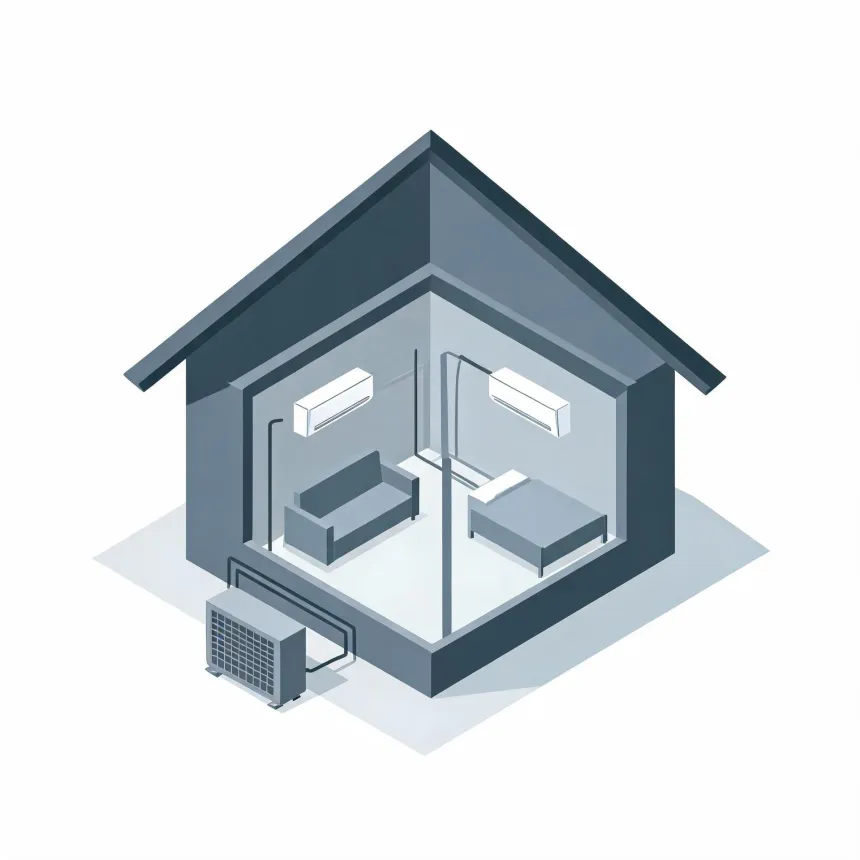
- A single outdoor unit can run one indoor head or up to eight, depending on the system. Each indoor head handles its own room or open area, and you size the unit to the square footage and layout of each space, not just a room count. A contractor will look at your home's floor plan to figure out how many heads you need and where they go.
- Can a mini split heat a whole house?
- It can, if it's sized and placed for that. A multi-zone system with a head in every room, or a properly sized single unit paired with good airflow between spaces, is how people do it. With winter nights here averaging 21°F for three months straight, the unit has to be rated to keep pulling heat at those temperatures, not just at milder ones. A contractor can size a whole-house system against your home's layout and confirm the equipment holds up down to your coldest nights.