Mini Split Installation in South Bend, IN
A new system here will heat from October through May and cool from June through August every year. Tell us about the house, and a licensed contractor who covers St. Joseph County will get in touch.
Tell us about the job
It takes about a minute.
What South Bend asks of a mini-split
Your mini-split needs to work eleven months a year here. Heat from October through May, cooling from June through August, and only a short stretch in between where it can rest. Winter nights average 20°F, cold enough that the heat pump side is doing real work. Summer afternoons average 81°F, which is moderate, but the unit still has to hold steady for three straight months.
Most homes here heat with gas, so a new mini-split is often covering one room or one addition rather than the whole house, and it needs to be sized for that job, not oversized for it. Whatever unit goes in, if it was built in 2023 or later it has to meet 14.3 SEER2 for cooling and 7.5 HSPF2 for heating, the same federal minimum as any other split system.
- 8 months
- October through May, your system heats
- 3 months
- June through August, it cools
- 20°F
- the average winter night it heats against
- 81°F
- the average summer afternoon it cools against
NOAA nClimDiv, 1991–2020 normals
In Indiana, HVAC licensing for homes is left to the counties and cities.
Whether a contractor needs a local license, just needs to register, or faces no rule at all depends on where the house sits, and there is no state list to check against because Indiana does not keep one.
What stands behind a mini-split installation here is the permit. Most cities and counties in Indiana require a permit before this kind of work starts and an inspection once it is done, and that inspection is what confirms the work was done correctly. That is the record this job leaves behind in St. Joseph County.
Sources: Indiana Department of Workforce Development · State of Indiana
- Is a mini split worth it?
- For the right room, yes. A mini split heats and cools one room or zone without ductwork, so it works well for an addition, a garage conversion, or a room that's always too hot or too cold. Your winters here run cold, down to 20°F on average overnight in January, so if you're counting on one to carry a room through the whole season, ask the installer to size it for that low temperature, not just for summer. Most homes here heat with gas, and a mini split can either back that up in one room or replace it there entirely.
- How many rooms can a mini split cover?
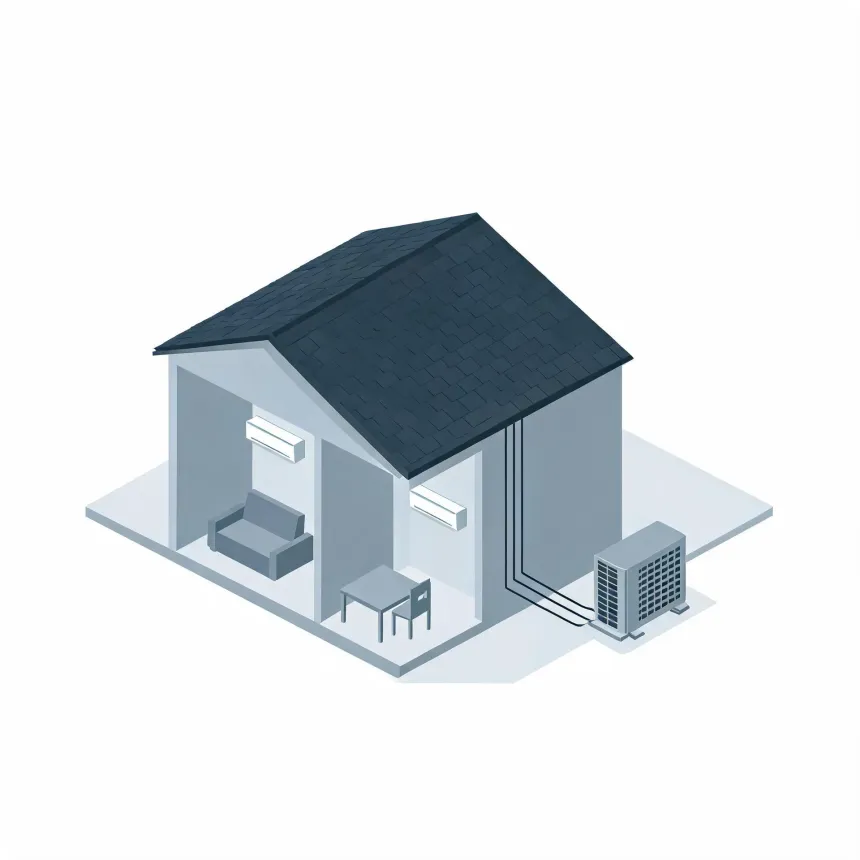
- A single outdoor unit can run up to eight indoor heads, each one heating and cooling its own room. That's a multi-zone system, and each indoor head is sized to the room it's in, so a bedroom and a living room on the same outdoor unit can each run at different settings. The more zones you add to one outdoor unit, the more that unit's total capacity gets split between them, so a contractor needs to size it against the rooms you actually want covered, not just the count.
- Can a mini split heat a whole house?
- It can, but it takes more than one indoor head to do it, and the coldest nights here are the real test. Winter lows here average 20°F, and a mini split has to be rated for that kind of cold if it's going to be the only heat source in the house. Most homes here already heat with gas, so a lot of homeowners run a mini split as backup or for the rooms the ductwork doesn't reach well, rather than replacing the furnace outright. Whether it can carry the whole house on its own comes down to how the system is sized, which is something a contractor works out room by room.