Profile view of a bearded man wearing a black baseball cap and a dark gray T-shirt against a plain light background.

How long an AC takes to cool a house in Indiana

Tune-up, service, or cleaningCentral ACIndiana
Step 1 of 2

What ZIP code is the job in?

A properly working air conditioner should cool your house by about 1 degree every 30 to 60 minutes, so dropping the house 5 degrees on a hot Indiana afternoon can take two to three hours. Indiana summers run humid, and humidity slows this down, since the system has to pull moisture out of the air before the house actually feels cooler. If your AC is taking much longer than that, or it runs for hours and the house still feels sticky, something is working against it. A dirty filter, a coil caked with dust, or a refrigerant charge that has dropped all make the system work harder for less cooling. None of that shows up as a dead unit. It shows up as a house that just never quite gets comfortable, and a bill that climbs while it tries. Catching that early, before a hot stretch in July turns a slow cooldown into a system that can't keep up at all, is the difference maintenance is supposed to make.

A woman in a gray turtleneck sweater stands by a window looking outside at snowy ground, with a dimly lit living room containing a sofa, shelves, lamp and a lit candle behind her.
A woman in a cream cable-knit turtleneck sweater stands in a warmly lit living room with a fireplace and shelves behind her, looking out a window toward snow-covered trees and a railed deck.
A woman in a cream knit turtleneck sweater stands by a window looking out at snow, with a lit fireplace, sofa and lamp in the room behind her.
A woman in a gray knit sweater sits by a window looking out at falling snow, with a dimly lit living room containing a sectional sofa, pillows, a lamp and houseplants behind her.

Why the cooling slows down

Humidity is the part that catches people off guard. Your air conditioner has to pull moisture out of the air before the house actually feels cooler, and on a sticky Indiana afternoon that takes real time. Two houses set to the same 72 degrees can feel different if one is more humid inside. If your system seems to run longer than it used to for the same drop in temperature, that's often the first sign something needs a look, not the heat alone.


What a well-kept system can do

A unit that's been kept up tends to hold closer to that 30 to 60 minute pace per degree, because the coil is clean and the refrigerant charge is where it should be. A dirty coil or a low charge makes the whole house work harder to get the same result, and you'll feel it as rooms that take longer to cool or never quite catch up on the worst days. Regular maintenance is what keeps that pace from slipping as the summer wears on.

A bearded man in a blue and brown plaid flannel shirt stands indoors looking out a window at snow-covered trees, with a ceramic mug on the windowsill.
A man in a blue T-shirt sits on a light gray sofa, laughing while looking at an open laptop in the foreground, with a framed picture, lamp and potted plant behind him.

A system running on schedule

A well-maintained air conditioner cools in a straight line. You set it 5 degrees lower, you wait two to three hours, and it gets there. The coil is clean, so it pulls heat out of the air efficiently. The refrigerant charge is correct, so the compressor doesn't have to run longer than it should to do the job. Airflow through the filter and ducts is steady, so every room gets its share of cold air instead of the rooms near the thermostat cooling first while the back bedroom lags behind. On a sticky July afternoon, this is what lets the system keep pace with the heat coming in through the walls and windows instead of falling behind it.

A system falling behind

A neglected system cools slower than it did last year, and then slower than that. A dirty coil can't pull heat out of the air as well, so the compressor runs longer to drop the house the same 5 degrees. A low refrigerant charge means less cooling capacity with every cycle. A clogged filter or a leaky duct run starves some rooms of airflow entirely, so the thermostat reads satisfied while the rest of the house still feels warm. None of this happens all at once. It shows up as an afternoon that used to take two hours now taking four, and a system that runs most of the day without ever quite catching up.

Power costs 15.96 cents per kilowatt-hour statewide

At 15.96 cents per kilowatt-hour, every extra hour your AC spends chasing that last 5 degrees shows up on the bill. A unit that's slow to cool because of a dirty coil or a weak charge runs longer to do the same job, and you pay for that runtime either way.

EIA-861 2025 statewide residential average

A gray outdoor air conditioner condenser unit on a concrete pad beside a house with horizontal siding and a light stucco wall, with a disconnect box and refrigerant lines on the wall and a shrub and mulch bed at left.

What a slow afternoon looks like

You get home at five, the house sat closed up all day, and you knock the thermostat down 5 degrees. An hour later it still feels thick. You check the vents and the air is cold, so the system is running. It just has a lot of heat and moisture to work through before the house catches up, and on a humid day that's longer than you'd guess.

A gray outdoor air conditioning condenser unit on a concrete pad surrounded by gravel, next to a white horizontal-lap-sided house wall with an electrical box and conduit, against a blank white background on the left.

What a slow system costs you

A sluggish AC doesn't fail outright, it just runs long hours without getting the house where you set it. That shows up on your bill before it shows up as a breakdown. A dirty coil or a low refrigerant charge makes the unit work harder for the same 5 degrees, and that extra runtime is the kind of thing a maintenance visit catches before it turns into a bigger repair.

Why does it feel like your AC can't keep up

You set the thermostat down and go about your evening, but an hour later the air still feels heavy and the house hasn't caught up. The vents are blowing cold, the unit is running, and it's still not enough. Maybe you notice the outdoor unit running longer than it used to, or the house holds that sticky feeling even after the temperature on the thermostat has dropped. Sometimes one room cools fine and another stays warm the whole time. On its own, one slow afternoon doesn't mean much. But if every hot day turns into the same long wait, something in the system, the coil, the charge, the airflow, is likely working harder than it should, and that extra strain is what eventually leads to a bigger repair.

A two-story gray horizontal-siding house with multiple gables, a covered front porch with white columns and railing, and a dark front door, fronted by a patchy green and brown lawn under a clear blue sky.

The weather service puts the average summer dew point across Indiana at 64°F for June, July and August. That's the sticky range, where the air already holds most of the moisture it can, and your AC has to wring that out before the house feels any cooler. It's a big part of why a 5 degree drop turns into a two or three hour wait instead of one. A unit that's behind on maintenance, a coil with some buildup on it or a charge that's a little low, feels this kind of air the most and falls further behind on afternoons like that. Keeping up with maintenance is what keeps a muggy day from turning into a long one indoors.

NASA POWER T2MDEW county cells weighted by homes

A local pro for your air conditioner maintenance

By now you know what's slowing your AC down and roughly how long the wait should be. What you don't know, standing in a warm living room at six in the evening, is whether your unit is running a normal Indiana summer delay or straining because the coil's dirty or the charge is low. That's a hard call to make on your own, and most people don't have a contractor's number saved for the day they need one. Finding one usually means searching, calling a few, explaining the same thing more than once, then sitting with quotes trying to compare them against each other. A maintenance visit gets a clear look at the coil, the charge and the airflow, so you know which kind of slow you're dealing with, and whether it's costing you comfort, money, or both. Handing off that search instead of doing it yourself saves you the evenings of calling around while the house sits warm.

  1. Thermostat calls for cooling and switches on the indoor blower.

  2. Refrigerant inside the indoor coil absorbs heat from passing air.

  3. The blower pushes that cooled, drier air through the ducts.

  4. Warm refrigerant travels outside and releases heat at the condenser.

Is Your AC's Wait Normal or Not

Normal summer delay

  • The house catches up in roughly two to three hours after a 5 degree drop, and that's expected on a humid Indiana day.
  • Vents are blowing cold air the whole time, and the air handler is running steadily rather than cycling off.
  • The house cools in a straight line, a degree or so every half hour to an hour, without long stalls.
  • Indoor humidity drops along with the temperature, so the air starts to feel lighter well before the thermostat hits its mark.
  • Closing blinds or running the attic fan in the afternoon doesn't change the wait by much, since the system was already working as it should.

System struggling

  • Three hours pass and the house hasn't moved 5 degrees, even with cold air still coming from the vents.
  • The air feels cold at the register but the room stays muggy, which points to a coil that isn't pulling moisture out anymore.
  • The outdoor unit runs constantly without the usual pauses, trying to make up for a weak refrigerant charge or a dirty coil.
  • The thermostat shows the set temperature reached, but the house still feels warm and damp an hour later.
  • Rooms far from the air handler stay noticeably warmer than rooms close to it, which a balanced system shouldn't show.
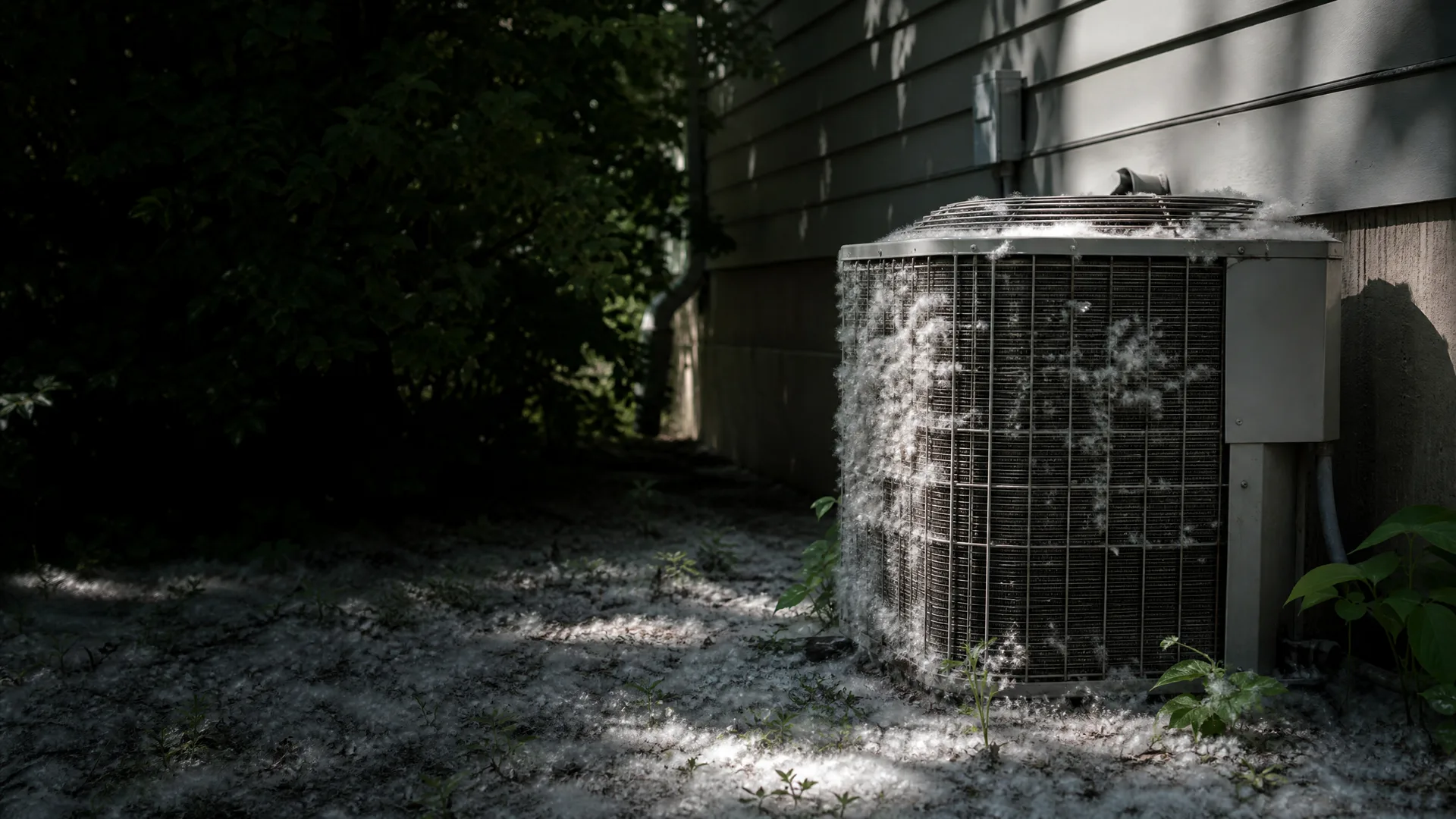
An outdoor air conditioner condenser unit beside a house with horizontal siding, its coil covered in white cottonwood fluff that also blankets the ground around it.

Late May, and the cottonwoods along the side yard have let go of their seed. You step outside to check on the condenser and find the fins coated in a layer of white fluff, thick enough to look like a dusting of snow. The unit is running, you can hear the fan, but the airflow through the fins is choked down to almost nothing. Behind you, through the open window, the living room still feels thick even though the thermostat has been calling for cooling since noon. You crouch down and brush a hand across the fins. The fluff comes away in clumps, and underneath it the metal is still packed tight.

A woman in a cream sweater and jeans stands in the open doorway of a white stucco house, holding the dark door, while a man in a dark quilted jacket seen from behind walks toward the entry past potted plants.

Two to three hours is the number to remember

A working air conditioner drops your house 5 degrees in two to three hours on a humid Indiana afternoon. Longer than that, and something is making the system work harder than it should: a dirty coil, a low charge, a filter choked with dust. None of those show up until you time it against the clock.

If you already keep an eye on small problems before they turn into warm evenings and high bills, the next step isn't figuring out which part is at fault yourself. It's getting matched with a contractor who knows Indiana summers and can look at your specific system, and having them reach out to you instead of you spending an evening calling around, explaining the same thing twice, and sorting through quotes.

A gray upholstered sofa with a matching cushion sits beside a potted plant and a wooden table holding a small green plant in a stone pot, near a curtained window.
Close view of a dark standing-seam metal roof with a stone chimney and metal flue cap, overlooking a wide river, trees, and flat farmland under a partly cloudy sky.

Get the right pro for your air conditioner

Find a pro near me

No fee to send it, and nothing to sign.

A technician checking the charge and cleaning the coil now means your AC isn't working harder than it has to on the next humid afternoon. Instead of calling around and explaining the slow cooling to one contractor after another, you answer a few questions once and a contractor who covers your area follows up with you directly.